Wednesday, November 12, 2014

Frost Watch


Smoke, our Icelandic ewe, is glad someone finally turned off the heat.

A few weeks ago we were in the first frost “watch” mode of the season. That is, the local prognosticators were calling for an earlier than usual first killing frost that sent many folks scrambling. But it never came. At least, it never frosted here at the farm.

But with this new, much more severe sounding “polar vortex” forecasted recently, frost seemed more likely to happen and it seems everyone is calling it quits on summer crops. (Whatever happened to the much friendly phrase – “blue norther”?)

At first, they were calling for a light frost, something that would give us a temperature range of about 32°F down to 28°F. This temperature range affects the most tender of your summer garden such as beans, cucumbers, eggplants, melons, New Zealand spinach, okra, peppers, pumpkins, summer squash, corn, tomatoes, amaranth, and winter squash plants, although if the skins are hardened on the latter, a light frost won’t affect the fruit itself.

Other conditions must be present for a frost to set up on the plants when temps are hovering at 32°F, such as calm air and a clear night sky. This is also known as a “radiation frost”, and is generally what happens when we wake to “Jack Frost” on the pumpkins for the first time in the fall. Although, with the way the winds blew in with much colder temperatures, this event may well qualify as an advective frost, as occurs with a strong cold front.

A hard freeze occurs when temps are colder than 32°F for four or more hours, and temps get below 25°F. Not too many veggies appreciate these temps, although winter crops such as broccoli, Brussels sprouts, cabbage, collards, kale, kohlrabi, mustard, onions, parsley, peas , (but you may lose the blooms), radishes, spinach, turnips, leeks, and sorrel, are often “sweetened” instead of damaged by them, and don’t usually require protection. Although I’ve been known to cover seedlings if they’ve not had a chance to harden off.


"Deep swings in the weather can take out plants that would ordinarily be hardy.  But then we never experience 40 degree temperature swings in North Texas, do we?"


Somewhere in-between these two lists are the crops that can usually take a light frost, but not the hard freeze and include artichokes/cardoon, beets, carrots, cauliflower, celery, Chinese cabbage, endive, lettuce, parsnips, peas, Swiss chard, escarole, arugula, bok choy, maché, and radicchio.

While the above lists are a good rule of thumb, and should be taken into consideration when planning your garden layout, I’ve seen exceptions to all of these rules at various points, on various plants. The more mature a plant, the higher off the ground it generally is, and the more susceptible to frost it will be due to losing contact with the ground heat. Deep swings in the weather can also take out plants that would ordinarily be hardy.  But then, we never experience 40 degree temperature swings in North Texas, do we?

Many factors can affect frost.
Sometimes, an area will escape a forecasted frost if it is somewhat protected by its micro-climate such as often exists in close knit, highly cemented, urban areas. The heat of the day is held in by the buildings, parking lots, and side walks.

That’s why many times a small backyard garden isn’t affected by a light, brief drop in temps, like one in a wide open space. Like this urban farm.

Although, if you have an inner urban property that exists at the bottom of a slope, or the top of one, you may experience a frost, while a neighbor on the side of the same slope, may not.

Experience over the years on a property is the best teacher for whether or not you’re likely to see damage based on a forecast – IF that forecast ends up correct. One extra push from a strong weather system, could mean an unprotected plant may not make it if temps end up dipping just 1 or 2 extra degrees.

It’s probably not too hard to cover most small back yard gardens, so if you want to try to preserve yours, you may as well be safe, rather than sorry, and cover it up. (More tips on how to do this, below.)

Time to Prepare
As seems par for the course, we had a few very nice days ahead of the predicted cold. I like to take advantage of those days to prepare. And we did just that here at the farm. Tugging on a 100’ x 15’ piece of frost cloth with 25 mph north winds can probably be equated to trying to struggle with the parachute of, say, the Jolly Green Giant during a Minnesota winter. Not fun.

And while it was still a bit windy while I was giving the farm intern his first experience with this winter weather drill, we were pinning frost cloth down in a brisk, easterly wind with the temps near 75°F, not 35°F. The wind chill is much more pleasant at the former.

Additionally, you’ll increase your soil’s heat holding capacity by about four times, if it’s well irrigated beforehand. That’s why you’ll hear me saying to be sure to “water in” your garden, before a frost. Cornell University says it can affect the air above the soil by 5 full degrees, which is a big deal when temps are hovering near freezing over your heavy laden, late fall tomato, basil or eggplant crop!

Some folks decide it’s just not worth the trouble to try to save summer crops and let them go by way of a natural season ending frost. But often, as had been the case the first few winters I was farming, the first predicted frost comes in early to mid November, the low temps last briefly, and there is little to no damage, followed by several weeks of mild weather.

We enjoyed summer squash well after Thanksgiving, tomatoes and summer squash at Christmas and didn’t have to cut all of our basil until around New Year’s. Lately, though, winter has been hitting earlier, and harder. Time will tell if the few hours of prep time will pay off.

To Cover or Not to Cover
By now, you’ve either decided to bother or not, and I’ve covered this topic a few times in the past, but it bears repeating. Frost cloth is designed to trap heat from the ground, under the blanket, not keep cold air from touching the plant.

It’s for this reason that unless you’re stringing lights inside the cloth to keep that palm tree warm, simply tying a sheet over the top of a tall plant is not likely to do much good. And I’m not entirely sure how well doing that works, I’ve never tried it.

Unless you’re able to keep soil heat radiating up inside that blanket to protect the plant, there’s a good chance you’re wasting your time making lollipops out of trees.   

You should never use plastic directly on a plant, without first protecting it with at least a cloth sheet. Plastic conducts the cold. A hoop over low growing plants is also helpful in protecting as a heavy frost can form on the surface of your frost cloth and burn the tips of leaves it’s touching.

So, in review;
1-Decide if the temps are going to dip below freezing long enough to damage, or just to chill the air enough for a hot cocoa. If you’re not sure, plan to protect plants based on predicted temps and above lists.
            Hard freeze range – 25°F or lower; 4+ hours below 32°F
            Light frost range – 32°F - 28°F, a bit warmer if dew points are right with calm winds and clear skies

2-Irrigate the garden soil, thoroughly. Moist soil holds in more heat than dry soil. (but don't forget to disconnect that hose when you're done!)

3-Foliar feed with a liquid seaweed, compost tea, regularly, but for sure before a frost. The higher the plant’s brix reading, (the more sugars present), the less likely plant cells will experience damage from the frost. Healthier gardens tend to fare better than stressed ones.

4-Harvest any tender fruits, such as ripening tomatoes, peppers, summer squash (and blossoms), even if you cover to try protecting the plant. Often the fruits themselves will not make it through if ripe or nearly ripe.

5-Cover the garden while the sun is still warming the soil in order to trap as much ground heat as possible. Use bricks, boards, sand bags or special frost cloth fabric pins to secure edges of cloth against the ground, closing gaps where air can leak in/out.

For the really adventurous, you can try to extend your growing season by a technique used by Eliot Coleman up in Maine where he gardens all year long. After you’ve covered with frost cloth, pull a layer of greenhouse plastic over top and secure the edges. This creates a deeper layer of protection, sometimes up to 3 zones worth of coverage, from a short blast of cold.


I tried it one year, almost by accident, and was pleasantly surprised by how well it worked.  

As I type, the temps are still in the mid 30’s, and the dew point was at 24°. I still don’t quite understand all of the meteorological factors involved in predicting frost, but it felt like frost was imminent earlier when I did my final walk for the evening.

And sometimes, a farmer’s intuition is all you need.


Eat Your Food - Naturally!

Marie

PS- We hit our goal, even exceeding it by a bit, for our on-line fund raiser last weekend. Thank you to everyone who contributed, pitched in by sharing, tweeting, etc. Watch for future blog posts on lessons with the new loader. 

Sunday, October 5, 2014

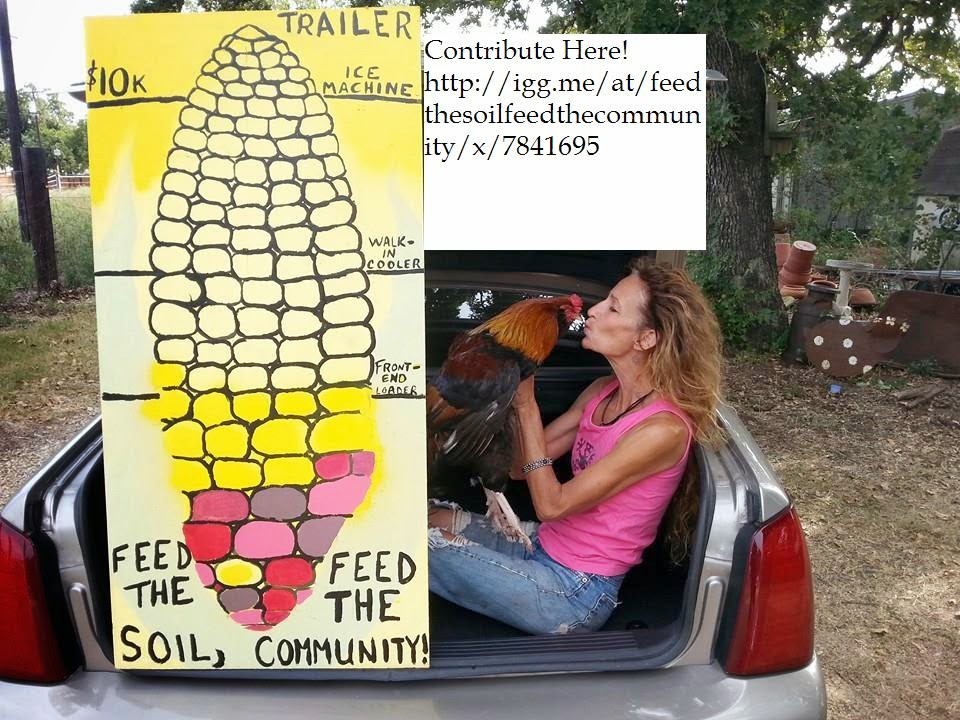
Make It Happen - For Compost


http://igg.me/at/feedthesoilfeedthecommunity/x/7841695
A little over a week ago, I dove head first into unchartered territory and began this farm’s first venture in #crowdfunding by way of Indiegogo, in order to raise a fairly large sum to pay for needed upgrades. It has been, and continues to be, quite exciting – just this week, a long time, very generous farm supporter issued an amazing “challenge” to others watching the campaign. She’s matching dollar for dollar any contribution that comes in, up to $5,000! Yet, running a month-long, on-line fund raiser has also been, and continues to be, a lot of work, with all of the emails, press releases, hash-tagging, and social media blitzing required to get out the word.

But without conventional means of income, it’s pretty tough to walk up to a banker, even my friendly home-town type, and take out a loan for anything - much less an after market front-end loader for a used tractor, a walk-in cooler and an ice machine. That’s pretty much how crowdfunding got started. People needed help pushing their potentially unconventional thoughts & ideas forward, so they turned to other like-minded folks en masse - grande.

And like many small business owners, farmers, it seems, are sometimes in need of this or that. And once we have “it”, we often wonder how in the world we ran a farm before we did. As much as I don’t want to use fossil fuel, (and I use it as infrequently as I can), at this stage in the farm’s development, on a 1-woman farm, it’s a necessary evil. With biodiesel only 15 miles away, at least I’m sort of green when I run the tractor. But I long for the day when ol’ JD only gets fired up to turn compost piles.

And turning compost piles, is the main reason to acquire a front-end loader for the tractor – at least for me. Sure, it’s going to make short of other tasks as well, such as carrying things around here that outweigh me. I’d like to still be able to walk and stand upright when I am 80.

But the ability to make one’s own living, breathing, compost source, could very well be one of the most significant advances for any small farm or homestead. It’s what could afford one to become nearly, totally, self sustaining. And that my friends, is one of the beauties of what organic farming is to me. Not having to trek to the store, or in my case the warehouse, each and every season to stock up on bags of commercially processed organic fertilizer and bottles of liquid this and that, is an important goal to have for truly sustainable agriculture to be realized.

I understand we live in a commercial society where everyone has to make a living, buying and selling things. And there’s always going to be some “stuff” we all buy so becoming “self sufficient” isn’t going to hurt the economy. Heavens, a garden center is one of the most glorious places to visit on Earth! I’ll always find my way to them and opening one was my first venture into owning a small business.

However, when did it become necessary for us to stock up on hundreds, even thousands, of dollars worth of soil amendments to put on our gardens each year in order to grow food? Well, I’ll tell you what I believe....

When we stripped them of topsoil in order to get rid of “weeds” – or worse, we doused them with poisons to do the job. 
When we stopped replenishing our soils with what was already present on the farm – or nearby. 
When we found a "miracle" in a bag, jar or bottle. 
When we got lazy, or too “busy”.

If you’ve ever watched Nature, you know she’s not lazy. Now she doesn’t work really hard either, and yet while she’s always “busy”, she’s busy working smartly. She stacks dead things on top of each other, adds water, leaves it lying there for animals to kick around and poop on, mix up and smoosch all down into the soil, and whalah – compost! 

Now granted, this method takes many years because it’s not heated up just laying there on the forest floor. But pick up a scoop of fresh soil off of the floor in the woods next time you’re hiking – and lift it up to your nose. I think it's one of the most wonderful scents you’ll ever experience. You can’t create that commercially and stick it in a bag.There are laws against it. No, really.

But, you can create it on your farm, or in your backyard, and spread it out over your crops or gardens. And if you can do that, consistently, I submit to you at some point, you’ll make your last necessary trip down the aisle of packaged "miracles" at the local garden store.

The insects will be more in check. Moisture will be less evasive because there’s ample organic matter in the soil to retain it, therefore reducing the need for this precious resource - as we enter our 5th year of drought. Weeds will become less invasive because the soil’s biology will begin to balance out and support higher forms of life, instead of desperately just trying to cover itself with whatever will grow there to keep from eroding away. Namely grass burs, Bermuda grass and fire ants.

Compost. It’s about balance. It’s about permaculture. It’s about working smarter, not harder. And that means working with Nature, not against her. Save that money you'd spend on "miracles", for cool new plants, more seeds, ceramic gnomes and fun baskets to share your bounty with friends. Compost Happens. And it makes your garden grow. Really well.

Thank you to all who have pitched in to help make this farm’s garden grow throughout our 5 years, and in this current on-line crowd funding drive. It better enables me to offer more real, food grown with integrity, to southeast Dallas County’s community where I live. And if you'd like to be part of the crowd - check out our campaign here.

I hope you'll all join us on Nov. 7th here at the farm for a little get together. It's the count down to the end of this campaign, as well as an early Veterans Day tribute with a mini film festival. Terra Firma, and time and weather permitting, Ground Operations will both be DFW area premiered on our big, outdoor, barn screen.


Eat Your Food - Naturally!

Marie

Sunday, September 21, 2014

Of Poop and the FDA


This week, after much revising, editing, re-writing and proofing, I will launch what is called a “crowd funding” campaign, to raise the funds to buy and have installed a front end loader on the farm’s tractor. This piece of equipment is the missing link of labor for being able to get manure out of the stalls, onto a trailer and into the fields in an efficient manner.

A front end loader will also make the many, many mountains of mulch sitting here turn into molehills of compost a lot faster. By being able to mix together bags of leaves and some of the manure with the mulch and put it into more manageable piles means the difference in usefulness of materials and, well, piles of stuff just sitting around waiting to decompose. 

Let’s face it, a front end loader makes a LOT of farm jobs more efficient. And we really need one. Here, on the farm. All of the time. I hope you'll be able to help the farm reach the full goal. (LINK http://igg.me/at/feedthesoilfeedthecommunity goes live this week.)  


I mean it's either a front end loader - or expensive hired help - a sure fire way to sink the financial sustainability of most small farms. I don't think an ongoing stream of a small army of poop shoveling volunteers exists and I've slowly but surely come to realize that relying on the unreliability of a former "partner" is no way run a farm, either, or live for that matter. A girl's just got to have her own equipment!
 

If I’ve learned one thing about organic gardening since I started farming that I didn’t know beforehand, (and trust me, I’ve learned way more than I ever dreamed I would!), it is that no matter how much bagged organic fertilizer you apply to the soil, no matter how straight your rows or how well you weed out the goat-heads, Bermuda grass and Carolina nightshade (aka bull nettle); none of this is a substitute for having microbiology in the soil. And being able to add and keep it in the soil, is a matter of having a way to do so without wearing out the body of the applicator.

Microbiology is the difference between dirt – and soil. (Or, in the case of this farm; beach sand with some red clay tossed in here and there.) Back when I was taking classes on horticulture, I would say that the soil I’ve been working with here, falls all the way into the lower left hand corner of the US Dept of Ag’s fancy soil pyramid. (you didn’t know there was a dirt pyramid did you? It’s sort of like a food pyramid – for soil.) That lower left hand corner is not a good place to be necessarily, if you’re trying to grow things besides pigweed, grass burrs, purslane or mesquite trees.

But, short of fixing soil the way Nature would, with a lightening storm sparked prairie fire, we can add organic matter manually – over and over and over – until the class of the dirt, becomes more soil-like.

Moving dirt’s structure up and over to the right on the pyramid where it really becomes productive soil, takes a lot of labor and a lot of organic material.

Ah, labor. When I started, I had quite a few volunteers and a full time job that supplemented the farm’s modest CSA membership funded budget. Secondly, renting a tractor with a loader for the weekend to help us, only set me back a half a day’s salary. The farm's production was very good, too, for the small area I’d planted. During a time of my late father’s illness, I gave up that full time off-farm job, and salary. But, without the off-farm job, the farm’s budget shrank and cash flow slowed considerably.
 
So, buying fertilizer in small increments seemed more manageable financially, than committing to several weekends a year of expensive equipment rentals. And fortunately while I still had some savings, I took the opportunity to purchase a small, low hour, very clean tractor – with a brush hog. (No front end loader. I didn’t realize back then just how important it would be to have that as much as the big mower it came with. But let’s just say I realized it a few years later.)

One way to add organic matter to soil, is to sow seeds in mass quantity at the time of fall or spring rains, let these specialized “crops” grow, then mow them down, chop them up and mix them into the soil. This takes a big, heavy duty mower – such as the one I have on my tractor. And I’ve done this many times during the several years I’ve been growing.

But, much like adding bags of commercial compost or organic fertilizer to the soil, without microbiology present, it takes much longer for the process to create a living, nutritious soil.

Enter – POOP! That’s right, manure.

photo credit - Joel Salatin at Carbon Economy Series Class 2014
It's got to be one of our greatest gifts in organic farming, to date. Better than any of the latest, greatest bottled wonders of laboratory created mixtures and concoctions, some of which are very good – when you’re not adding them to a soil that’s devoid of any life forms other than fire ants.

They say when you put a teaspoon of soil under a microscope you’ll see a colony of millions of microorganisms. Clearly, they’d not seen my soil. It looks like crushed glass mixed with dark grains of crushed pepper or something. Virtually lifeless and still.

In order to have life in the dirt, making it soil, you must have residents of life.

And in order to learn about that, you have to look someplace besides your Biology of Horticulture textbook. Microbiology is not even in the index – much less the table of contents. Neither is the word microorganism.

However, it does speak of manure. Although, I think it misses the real magic that manure adds to the picture of creating healthy soils. All of the things the textbook claims about manure’s ability to help keep soil warm in a greenhouse because of the exothermic bacteria decomposing the manure; its addition of macro and micro nutrients and nitrogen, etc., are true. But that’s about as close as it gets to talking about the real benefits of adding manure to one’s soil.

But organic farming is what it is because over the centuries – literally – things have pooped on top of the soil and stuff grew there. 

The real magic of manure, is the wonderful and complex community of microorganisms that comes with it. Without this, sandy soil is basically a lifeless, medium used to hold up plants. With that community – you can feed the world. Seriously.


Fortunately, this farm does have a small army of poop makers – and they make a pretty fair amount of it. It has also been the fortunate recipient for the past 4 years of tons, literally, of shredded tree trimmings via the local tree trimming company who saved me after the 2008 tornado that hit here. Mix in a few hundred bags of leaves and some moisture – WHALA! – you have a living, breathing, multiplying source of a wonderful and complex community of microorganisms to add to that lifeless medium that will turn it into – SOIL! Better than any bag of commercial compost you can pay for.

But organic farming is what it is because over the centuries – literally – things have pooped on top of the soil and stuff grew there. It’s a simple, proven, like it or not – FACT. And I couldn’t have been happier or more relieved to see that the FDA has actually at least paused for awhile on their initial knee-jerk legislation to take away one of the most important tools organic farmers have in their tool-belt because of people’s germ phobias. (Be sure to send your comments to them on the revised provisions - comment period opens at the end of September.)

The application of raw manure to soil, well in advance of harvesting any food, is very important – dare I say critical to healthy soils and therefore to crop production. The presence of living bacteria is what breaks down not only the manure itself, but other organic materials such as previous crops, weeds, leaves, bags of organic fertilizer and whatever else used to be on top of the soil that manages, either through tilling or light raking, to get close enough to the bacteria. And it is through the breaking down of these materials, that makes available to the plant, the macro and micro nutrients that most textbooks focus on.

Without organic matter and the microbiology present, those micro and macro nutrients, no matter how applied, in a sandy soil either leach away into some black hole unreachable by cultivated crop roots (or downstream somewhere), or sit there locked up waiting to be discovered – as is often the case in the more dense, gumbo-like soils of most of north Texas.

It is true as I previously noted that you can take mounds of mulch, stalls of manure, bags of leaves and pile them up and turn them, creating a wonderful compost. And this can often be the difference in a well-realized harvest, or a fair one.

However, through the very process of commercially decomposing organic matter at the high temperatures required by various laws, a lot of that community of microorganisms perish. Even in a home made pile heats up to 140°F or so. Still better than nothing, it isn’t the same as being able to spread manure, straight from the stalls, coops or lean-tos, onto the fields in-between crops. Ask just about any organic farmer. They don't need a 5 year study by the FDA to tell them this. But we'll take the 5 year reprieve and hope some big chemical company - ahem - doesn't fund the study.

And some new farmers, like me, may tell you it took a few years of literally observing the difference between a crop grown from fresh horse barn bedding versus that grown from soil fertilized mostly with bags of organic fertilizer, to realize just how MUCH of a difference there can be. After all, the commercial organic fertilizer companies would like you to think you just have to add their stuff and have bounties of harvests.

But, once the life in the soil begins to die off due to lack of moisture, excessive heat or cold or other often weather related factors, that organic fertilizer doesn’t do nearly as much good.There's nothing left to break it down so the plants can use it. You have to add more manure and living compost.....

Enter – a front end loader to the rescue!! I know it took a long story to bring you here, but it’s been a good lesson in soil building for those who may have wanted it. 

So thank goodness for Indiegogo crowd-funding campaigns and the countless number of people who wrote to the FDA calling for common sense when it came to pretty much ending organic farming as it has been known for centuries.

We’re going to have a poop scooping party after I get my tractor back with it’s shiny, new front-end loader attached! And our friend Elizabeth Dry's community gardens at Promise of Peace, and Farmer Jones Eco Friendly Produce are first up on the list of places we're going to bring it to help out - as soon as we get that new trailer. ;) 

Marie Eat Your Food - Naturally!