Tuesday, March 3, 2020

Not To Get Controversial, But....


I don't normally talk a lot of politics here, because, well, let's face it, it can get controversial and for whatever reason, affect people's opinions of others. However, if I've learned one thing over the years, it's that listening to someone whose opinion or point of view may differ from mine, can be enlightening, educational and a good experience. So, I'm gonna go out on a limb here on this Super Tuesday.


People who are self employed, like farmers, are often doing so because they like the independence it gives them. The flexibility in schedule, the ability to choose their vendors, customers, hours (more or less), and the freedom to choose daily tasks – I mean, overall, being self employed is awesome. 

Now it also means I have to be available 24/7, 365 - basically, paid vacations are a fantasy, sick time is just that, sick time – while working. Being the bookkeeper, shopkeeper, housekeeper, animal steward and customer service department; all wrapped up in one. And I know a lot of people who would never choose to step out on their own and go into business for themselves because it's, in their mind, too risky. It takes all kinds of us to make the world go around and I love that!

But, choosing to be a small, independent business owner should NOT mean, they can't go to a doctor to have something checked out that might be bothering them or a kid; shouldn't avoid get routine dental cleanings, because it was too expensive, (like $500 expensive), to go each year and have them cleaned professionally, to avoid the level of problem that led to more expensive treatment like filling a small cavity; or stretch a contact lens or glasses prescription out for twice as long as it should be – because it's that or feed the animals and their kids each month. Buy a part for the tractor. Get the inspection sticker and registration for the truck. Feed their kids something besides beans and rice, ramen noodles and water.  Till somehow, something extra comes along. 

Here in the state of Texas, apparently the affordable care act fell short of being very affordable for many folks. I won't dig into the politics of why, there are many reasons and none of them we should be proud of, but suffice it to say that paying $300-$500 month, every single month, for health insurance, (not even CARE),  that wouldn't even cover eyes or teeth, is shameful. And, unaffordable for way too many people who work very hard, often at multiple jobs, but just don't make the kind of money to cover it, or work for an employer who helps pay for it.

Now, thankfully, I personally have found a local dentist here in town who believes preventative care for families is very important and prices her services accordingly. (you can get a full exam including panoramic and individual x rays AND a basic cleaning for under $100!) And, in Dallas we happen to have an amazing College of Dentistry downtown that accepts patients for their students to “practice” on. I even gave two of the student dentists my perspective on how important dental care is to the overall health of people because good teeth, or bad ones, determines what a person is able to eat. I know too many people who can not eat raw carrots, broccoli, or eat corn on the cob and don't have a juicer to suck them up through a straw instead. Fresh vegetables are imperative to a healthy diet - a healthy person. Being an affordable dentist, at least on the front end of prevention, can go a long way to helping the overall health of our country! I think I left them both with something to ponder.

But if someone can't afford to do anything but get a tooth yanked out, what can we expect as a society? And then yes, we all suffer because those who can't afford any medical care often end up in publicly funded facilities. Which is great, and I gladly pay my Parkland taxes every year and while I hope not to ever need their care, am grateful it is there for those who do. But what about those who don't have a Parkland nearby?

I am super lucky to have an MD and an ophthalmologist on my CSA roster, and they have pledged to take good care of their favorite farmer at a price I can afford. Both also operate in lower income areas and have rates that are substantially more affordable than what I used to pay elsewhere. But this kind of opportunity isn't available to everyone. 

And not everyone can get to these places – or even knows about them. I had no idea any dental office charged less than $300-$500 for a basic appointment and cleaning. I called around and gave up a decade ago.

Not all medical offices are set up where rent isn't super high or a good deal on a real estate purchase was found. I get that. Everyone has overhead. Maybe it's time we stop charging medical offices a higher tax rate than churches? Both provide services considered essential to the well-being of the people, right?

And who knows how much some independent offices are being raked over the coals for for medical supplies, etc because they can't buy in bulk like a huge corporate hospital or chain of physicians. 

I don't expect them to eat that cost, they have bills to pay, just like me. If I am forced to pay more for seed or equipment, I have to find a way to recover that cost so I'm still making a living. Doctors do, too.

Capitalism can be a great thing, I say that as an entrepreneur - until it gets greedy and goes unchecked. And my friends, I think it's fair to say it's gone unchecked for quite a few decades now. 

"Breaking up ma bell" was supposed to lead to cheaper phone bills - has it? Deregulation of utilities means we pay more for internet service than just about anywhere else in the world. Government granted monopolies means less competition of unregulated services - and we are left without options.

What would happen if all of the food growers and suppliers got together and decided people needed to actually pay for the cost of production instead of the deeply discounted food prices Americans have come to enjoy? You pay for the difference in gas prices with subsidies paid some corn growers whose product ends up in your gas tank. Or in the beef you ate. Or in the $1.99 gallon of milk or the 3 loaves for $5 bread. Do you really think that stuff is that cheap to make?

My point is that some parts of the medical industry in general seems to have lost sight of its objective and instead focus on profits, too often at the expense of people's health and well-being. I always thought it was to help keep people healthy, and to cure them when they're ill.

Kind of like farmers. My objective is to feed people healthy, nutritious food. No one is saying both professions should not be paid fairly for their work – both have bills to pay, of course. But if a farmer wanted to feel ok charging higher rates, I think they'd raise something people didn't require on a daily basis to survive - healthy food. 

They'd raise cotton or wool, or silk and it wouldn't be subsidized. You won't die if you don't wear it, but if you prefer natural fiber, is going to cost a bit more. Synthetic fabrics are available, and usually cost less. But there is no good substitute for REAL FOOD. We know that because obesity, diabetes and heart issues, not to mention cancer, is affecting the Western diet followers much more than others who eat fresh foods. But that's a different rant.

People in general who enter service oriented industries such as teaching, emergency services, health-care workers, agriculture, and medical services – generally, have their end customer's well being in mind. Not their pocketbook.That's what I'm trying to say.

And isn't it time we help take better care of those who take care of us by guaranteeing they can get the same kind of medical care someone fortunate enough to have a great medical insurance plan, or who works for the government (at just about any level), would afford his or her own family? Even sometimes there are doctors who can't afford services of some other doctors.

There's something wrong with this picture when we have friend after friend holding a “go-fund-me” drive to help pay for breast cancer, accident recovery, critical care for a child; because they're going broke and homeless otherwise. 

It's inhumane the same way it would be if people were turned away from food if they needed it and couldn't otherwise afford it. Most farmers I know would at the very least offer a "will work for food" opportunity or a sliding scale option for those in need. And so do many physicians. But what about higher up that food chain?

No one is saying medical care should be "free". Nothing is free. But if we all contribute according to our ability, we can do better for everyone in this country. Our friends, family and neighbors, as well as those we may never meet. 

And, we all know that even at our own local government levels, there are plenty of things we spend tax money on that is “fluff”. We know there is plenty of money that is spent on things we could do without so much of, and not jeopardize anything we've come to expect as US citizens. It's all a matter of priorities.

Somewhere we've lost sight of the importance in caring for the vulnerable and the ones who care for and do for others what many would not either like or be able to do for themselves. 

We who do those things and work for ourselves or those companies who aren't big enough to afford it for their employees, are no less worthy of medical care than someone who takes your call at a huge nationally owned corporate cable tv office, bags your groceries at a huge national supermarket chain, builds your cars, or your houses – someone who chooses to clock in and out each day, and works for a business who is able to offer some sort of health care to its employees. 

Small mom and pop local businesses who employ others, they're taking a hit, too. Paying both an employee's social security and medicare shared amount AND a health insurance premium employers share for its workers, is no small expense. Which is why fewer can afford to offer this “perk” and don't, or don't have employees. 

And millions go without medical care each year. Without their meds, preventative exams, dental cleanings, eye glasses, surgeries. We all see the posts on our social media feeds. This is a real problem for real people. I doubt, unless you live in a bubble, you don't know others who face these life and death issues. Some of them, every day.

We are a great place to live. I consider myself very lucky to have been born to parents who were born to parents who chose to come to the US for the opportunities it offers. We have some of the greatest engineers and ingenuity in the world. People love to invent, to develop and create, and get paid for it.

But, most people, I believe, want to help other people succeed, live better and be healthy. And many come here and can't understand this "live and let live" or "dog eat dog" philosophy that has seemed to take hold here. Where is our humanity?

We can do better by each other if we pull together, do what we do best and do it better than anywhere else, instead of looking at the worst of everywhere else and saying we can't do it here because "over there they have problem x, y or z".

Is there someone out there running for office who seems to have the well being of those who don't have a lot of pull in mind, and has been fighting for their rights for many, many decades? It's not all up to one person; I get that. But it's a mindset that gets voiced from a position of leadership that helps influence society. And then they're going to need the people behind them to make it happen.

So, all I'm asking is please, when you cast your votes this year, look at it from the perspective of someone else, too. Thanks. 


Now, Eat Your Food - Naturally! If you can. And if you can't, get a juicer or a blender at the thrift store and grind that stuff up because it's going to make you feel a LOT better than that heart attack in a bag that only costs a buck. Said with love, from your favorite, local, small, self employed farmer.

Marie

Tuesday, November 5, 2019

Winged Intruder


Sleeping solidly through the night when you live on a farm isn't always something you get to do. At least, I don't. I seem to sleep with one ear still "on"; listening for out of place noises. 

Living on a farm one block north of a freeway in a place with a prevailing southerly wind, makes discerning noise a bit tricky.  When the breeze is out of the north, or calm, it's very quiet around here. But when carried by Gulf breezes, the constant hum of freeway noise, blow outs or hot rodders; it's not always easy to separate noises.


Well, last night, there was no doubt the sound of the Great White Pyrenees alarm, followed almost immediately by the screeching guinea fowl alarm. 

I jumped up, threw on my robe and slippers, meaning to put on my Sloggers, and grabbed my phone - in the event it was a two-legged intruder - and rushed out the back door to see what the clatter was all about. 

And it's not even the night before Christmas.

Anyway, I arrived and looked around, scanning ground and then sky - just in time to see the shadow of a pair of vast wings slowly ascending off into the night sky. I so wish I could have fired off a photograph. But as it flew off, unable to make out if it had something in it's talons or not I supposed if it had something, I'd have seen it. Perhaps. 

I didn't stop to grab my spectacles on my way out the door. 

It grew quiet almost instantly as the winged invader flew off. And the only noise now I tuned into, was that of the creaky, squeaky noises the guinea fowl make when they're not screeching at full volume. 

I located where it was coming from, and quickly counted the white heads that almost glowed in the dark. Four. I should have 6. Not believing even a huge barn owl would carry off two birds at once, I decided if the other one, or hopefully both, were still around, they'd be huddled together in silence. 

So I herded the four I could find through the dark of the night with my familiar "feeding whistle tune" and slow movements into the chicken coop area they are supposed to sleep in. Locked up the door, and when back to try to find the others. 

There it was! I heard the distinctive noise, quiet, yet familiar. Was that a flash in the brush? My good flashlight lay on the desk; I will remember to put things back where they belong so I can quickly grab them; some day. 

So all I had was the dim light from my cell phone to search. Then from behind me, I heard a much more distinct chatter. Up in the tree was the lightest colored of the birds, one of the males, near the lower branches; not where he usually roosts. Surely they were rustled out of their sleeping spots. Of that, I had no doubt. 

I searched and sat quietly for over 10 minutes but just couldn't find the other bird, likely this one's mate, anywhere. So I decided to let him stay in the tree for the rest of the night. If indeed it had been the other bird I'd heard, and not just this one's call bouncing off the wall of the barn back at me, he'd find her in the AM. 

And I would be out at dawn with feed, to be sure they didn't wander off before accounted for. 

So, with that in mind, as if an alarm went off in my head, my eyes popped open at five after six and off I went, fully dressed this time, to the barn to snatch up some feed for my likely sleepless, feathered friends. 

First I called to the male in the tree, and as soon as it was lighter, he swooped down and came running for his snack. Trying to lead him to the other 4 in the coop, I walked slowly dribbling grain behind me. 

He came as far as the gate to the enclosure and then ran back towards the tree. No, this way! Silly bird. So I let the other 4 out, giving them some grain as well, and to my pleasant surprise, I turned back around the rain barrel to find my guinea pair - reunited! 

I was so happy I nearly cried. You see, guinea fowl, as I understand it, mate for life. And if they're separated for some reason, will often remain unpaired for the rest of their life. That always made me kind of sad to think of, so I was very happy to see his mate had survived the attack from our late night, winged intruder. 

Perhaps, but not likely, they will choose to sleep in their enclosure now..... one can only hope. Because, our intruder will surely be back.

Marie 

Eat Your Food - Naturally!

Sunday, August 18, 2019

It's a Dozen!

aprx 12 min read
Here is the garden right after an old cowboy boyfriend spent several days running over old, hard, over grazed pasture with an old arena disc, then getting several inches of rain, and then paying a farmer with a tractor powered tiller.

Heavens to Betsy - I'm starting my 12th year of farming! Looking back over old photos, blog posts, both of mine and fellow farmers, so much has changed on this farm in Balch Springs, TX since I broke ground in August of 2008.


I had full time job, a tiny little tiller, (still somewhere in the garage), that would beat the heck up out of me when I used it on the west side of the gardens due to the mix of red clay; and would sink practically up to the motor on the east side, because it was nearly all sand.

Some "young" farmers posing for TXYFO at a TOFGA conference in Rockwall, TX
 I was fortunate enough along the way to have so many wonderful TOFGA farmers to turn to for advice, guidance and good deals, especially when I first started out in 2008. The great, late, Farmer Larry, from Austin's famed Boggy Creek Farm, (far left) sold me two heavy duty walk behind tillers for less than it cost me to get a brand new motor and have it installed in one of them. I do still pull that one out to fluff up the soil when I need it, or to break up the mixed clay/sandy clods when the soil is just the right consistency.

Local former feed/farm store owner Jack (r) and his nephew another Larry I knew, (l), with the "big blue" tractor and tiller when new ground needed to be prepared.


Then one day early in 2009, I lost my father. I had originally left my full time job working for an ornamental grower to help him as his health was not good. Up until then, I was only farming part time, at night after or early in the morning before my job. I was going to work the farm in the morning while an aid tended to my dad for a morning nurse's shift, then clean up and head to my father's apartment to get him an early dinner, his RX's, and get him to bed. My plan, also, was to build him a 10x10 tiny home on my property to live, so the commute to Richardson would end. He, being a heavy smoker, and I, having an affinity to catch bronchitis, couldn't ever be roommates. But having him on the farm would enable to keep an eye on him, cook (good food) for him and run him to the doctors as needed.

He'd only been to see the gardens once since I broke ground and it was on a wet, cold, November day. I was bringing him home but detoured to the farm to cover tender crops with frost cloth before an impending cold front. He shook his head, almost in disbelief for the project I had only recently told him I'd undertaken. "Where's all of your help?"  I remember him asking when I returned to the truck, soaking wet from the cold rain. I think he thought I was nuts for becoming a farmer. But what he didn't know was that the cathartic value of being in Nature, working the soil into something living and the reward of seeing the fruit of my work, would be what helped carry me through the season following his death. 

Later that year, JD came into my life and nothing was ever the same! JD was not very big, as some might say, but he was strong, and he didn't have very many hours on him, yet he never complained how many hours I worked. He came with a brush hog and a free mini-tractor driving lesson so I could get him home; about a block down the street.

JD - one of the best investments for the farm I ever made!

Having this tractor enabled me to clear an area of weeds and grass myself, then using the walk behind tiller, mix in amendments and have a nice, fluffy bed in which to plant. Plus, I was able to mow trails for hiking around the farm - so I didn't have to fight off chiggers....

 Later that summer, the local tractor store - that I miss so much today - turned me on to a place called Steven's Tractor in Louisiana where I got a multi-purpose implement that further made my life easier. It had a large spade, for digging ditches, planting and harvesting potatoes, as well as cultivators (which I'm still not very good at using), and a set of scalloped discs for helping make raised beds.


They carry all sorts of custom tools and parts for older tractors like mine. Bookmark them and if you're on it, Like them on FB! If I had more cash flow, I'd be a regular shopper and have all sorts of more tools!

Work-share families helped make a little lighter all of the weeding and harvesting.
But, I learned to get along with what I had for the most part and in the early years I seemed to always have at least 2 or 3 work-share members that came out once a week to help make a little shorter some of the backbreaking work.

Back in 2015 I guess it was, I did add another valuable implement from Larry - with the big blue tractor - who was selling off his smaller tractor attachments. I picked up a disc, which has nearly replaced my need for the walk behind tiller. It isn't as harsh on the soil, not that sand really builds up much of a hard pan, but it also helped me to bust up Bermuda grass over and over during the hottest part of the summer, helping to kill it out - for a  season anyway - and get my fall crops in a little earlier. I now also use tarps to help with this task. You can call it a 1 - 2 punch I guess.  That devil's grass still comes back thriving each spring though....

And that's been probably my #1 biggest pest - Bermuda grass. Starting a farm smack dab in the middle of a horse pasture, once seeded with common Bermuda no less - was to be a lot more troublesome than I expected. I have not ever used a synthetic herbicide on it, so exhausting its food source from the sun is my best option. However, being what it is, persistent, unless I did this to the entire perimeter around the 2 or so acres, it would always find a way to creep back in; under the ground, over the cardboard, around the barriers. To fight it to its death naturally has thus far proven futile. All I can do is delay it.

If I had any real sense I guess I'd invest in some square bale equipment and just become an organic hay farmer - and don't think I've not considered it.

But growing food for people's consumption is what drove me into this field of work and unless we really evolve, hay is not in our diet. Not directly anyway. In 07 when it became clear that there weren't enough local farmers growing unconventionally in the area to fuel my Market Days, I decided to grow some myself. I picked up a few farmers each season, but rarely did they consistently have produce year round. Many retired, moved away or were lost to this world too soon. But until the past few years, I was always able to share a few farmers and organic value added producers with other local markets that only met opposite my market's days. That ended several years ago and it became harder and harder to compete with the higher traffic markets. My community appreciated me being here, but not in the numbers needed to help support multiple farmers needs.

So over the past decade I've learned a ton about growing seasonal food for myself and my community and strive to provide as much as I can above and beyond what I grew for my CSA, who are my main source of income. I never imagined I would have to learn to grow at such large quantities and I still struggle to do so with the limited equipment and lack of help I currently have.

Joan Firra, semi-retired physical therapist & original member


My CSA membership's core of about 26 +/-
paying members have been with me for an average of 9 years, with one being an original member from day 1! We pick up new members each season, and we lose a few as well. Some families move away, or decide that CSA just isn't for them.

Eating primarily in season off a local farm that you visit once a week is a lot to ask someone. But understanding that the small, local farmer is not usually intending to totally replace your trip to a farmer's market (or, even a supermarket if need be), is important to feeling like a CSA is worthwhile for some.

Sometimes people are not happy that I don't grow what they're used to getting at a supermarket. There are just certain things that, over the years, I've learned are not viable to grow here on this farm. At least not that I've found a way to grow yet. I'm always trying new varieties of vegetables and fruits, and most recently have been adding perennial things such as fruit trees and working to tame our asparagus. The Bermuda actually makes perennials more difficult to grow because I can't just toss a tarp over a freshly mowed area or I'll wind up killing the food crop, too.

I'd like to be able to produce sweet potatoes, probably more than even my members, as it's one of my most favorites. It's not a highly labor intensive plant, but I have an army of rabbits that enjoy eating the vines as well as a soil that seems not to support a very robust crop. Each spring it seems we get heavier rains that wash nutrients out of the soil that are important to the healthy development of sweet potatoes. Thankfully, harvesting my own slips from a local sweet potato farm saved me tons on that lesson learned.

But not so much on the hundreds I spent on shipping in certified organic seed ("Irish") potatoes from CO for several years. I never could sell enough through the garden center to pay for them, so it is a crop we all miss dearly. And one I'm sure I'll look for a way to re-incorporate back into the mix at some point.

Probably the most important piece of equipment I added to the farm other than the loader for my tractor - which was made possible by a crowd funding campaign in 2016 that blew me away and still does - was last year's acquirement of the high tunnel through the USDA's NRCS program and built primarily by volunteer farmers from the area.


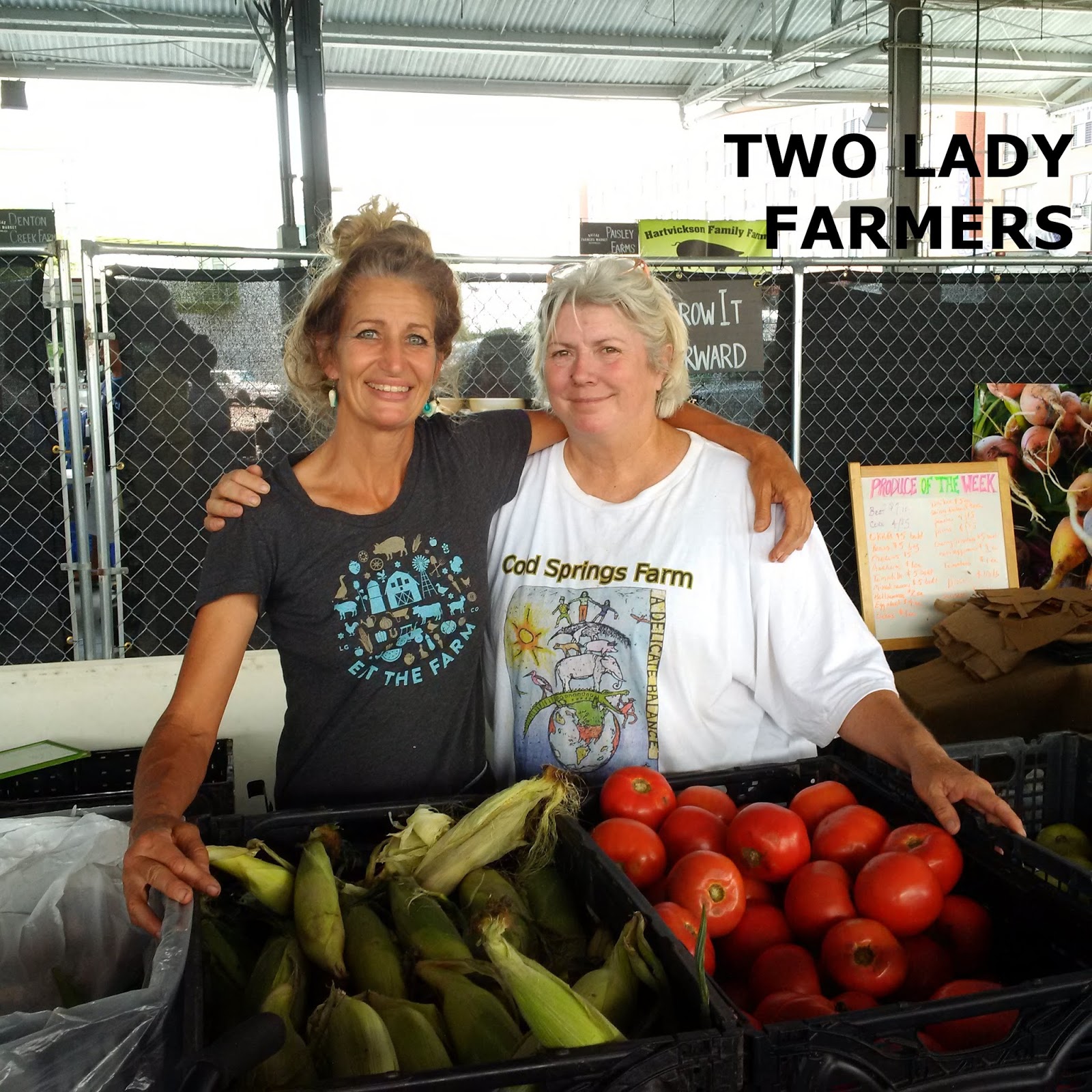
Thanks to the urging by dear friend and fellow lady farmer Beverly Thomas of Cold Springs Farm, I took the leap and signed a contract to get the 30x96' structure, fully reimbursed or I'd never been able to afford it.


Now, a high tunnel in N. Texas may seem odd to those who use them for cold weather season extension in the north. But protecting the top soil from our ever increasing flooding spring rains, means less leaching of nutrients (that become expensive to add each year over and over after flooding rains), less loss of seeds sown, and less erosion. It also made a big difference in the heating degree days for our late fall and winter crops as well and we enjoyed a more robust harvest from November through late spring than in most of our past years.


Every year I learn more and do my best to pass on some of my knowledge to others. From work share members who go on to farm their own land, to on farm residents and interns to garden center beginning gardening classes; it makes me so happy to learn that others have benefited from what were sometimes, my mistakes.
 
Last year a young man from Wisconsin wandered on down to Texas to pass some time away from the cold winter and found my farm through the local FFA group. He was amazed at our growing season and gleaned all he could, taking back his new-found wisdom vowing to grow more food up north and return this winter to work with me again.  Maybe even permanently! Boy that would be a big help!


Chef Dave Gilbert was the first chef for whom I grew produce
As for now, I've downsized a bit, only growing for my CSA and local market, chefs as I'm able, instead of relying on that income and killing myself with all of the extra hours it took to harvest it all, (at one time I was offering crops to 15-20 chefs a week). Once I get the hang of growing in the protected environment of the high tunnel, which is different that out in the field, I hope to be able to again become a regular name on a few menus around town.


Since it's hot as a kiln and dry as a bone outside as I write this, you can imagine other than watering everything endlessly, there's not a whole lot of farming going on. Fall seed trays are going in hopes that the ground will be ready to receive the transplants when they're ready, tomatoes, peppers, a bit of arugula and eggplant are hanging on for dear life in the high tunnel, which desperately needs a $500 shade cloth the farm just can't budget for right now. And the fields are hosting watermelon and more eggplant but just last week laid to rest the cucumber and what was left of melons patch. Okra is stunted for some reason, but putting out a little bit of produce whilst providing some much needed afternoon shade to recently planted winter squash transplants we hope to have in time for Thanksgiving shares.


 Farmer Brad Stufflebeam's (left, barking out information to us students) priceless grower's symposiums that I attended on his farm in Brenham two years in a row my first and 2nd years farming...


Farmer Beverly Thomas - an overwhelming source of support and information to me
I owe any success I can claim to the many farmers who came before me, some to whom I owe much more than others, as well as the many DFW area folks who strive to consume a more clean, local diet that pay my salary so I can scratch out a living doing something I love;

An early days Market Day

One of my favorite parts of Market Day guests; sharing the livestock
Former CSA member took me to lunch just before moving out of state.
both as their own private CSA farmer and to those who have come to the many Saturdays of market days when we have enough produce to go around.


And to the many, many volunteers who have come to pull weeds, shovel compost, harvest produce and so much more - I never could have done it all without your generous gift of your time!


Ground breaking, spreading manure with volunteers and neighbors


Happy Anniversary to Eden's Garden CSA Farm, and here's to at least another twelve!! 


Marie

Eat Your Food - Naturally!