Showing posts with label Eden's Garden CSA Farm. Show all posts

Monday, September 7, 2020

Dog Dayz 2020


August. The bane of many an outdoor worker's existence. 


I finally dusted off the window unit and took solace inside during much of the heat of the days the past couple of  weeks of triple digit temps. 


It was all I could do to make sure I was up and out to keep water buckets full, make sure no one was stuck in fencing, supplement animal feeds, and collect eggs before they started to cook in the shells.


August is a hard month on the farm. For everything. Plants, animals and people.


Most of us have been going pretty much non-stop since January; February at the latest. Planting, weeding, nurturing, harvesting. Harvesting. And more harvesting.


If I don't see another stalk of okra, it'll be OK with me. This year I discovered, after having a full bed of Pick Your Own, that very few enjoy picking themselves, it gives me a severe case of contact dermatitis unless I don long sleeves, gloves and long pants. That's not so fun when it's 80 and 60% humidity. 


This was the first year I planted “cow peas” and they just never stop! I picked and picked and then the heat dried so many on the vine..... so now I have a bunch of dried peas to pick and shell..... or turn into the soil as green manure, which is what it's really good for.


So I tend to look forward to a short break in August when I'm just harvesting what I need to eat, any burst of surplus for our local food pantry or an occasional pop up market.


With COVID this year, I pretty much took a hiatus from full-fledged market days. A few people stopped by on the 1st and 3rd Saturdays, and I sold what I had. But I didn't make a big deal out of it this year at all. (We just quietly celebrated our 13th year)


Under normal circumstances I welcome folks to the farm. But, I live here and touch everything all of the time. It's not like I hold market in a sterile parking lot. I didn't want to take the risk for myself or anyone else.


So August was hot, humid and for the most part, quiet and dry. And during that time, even though it's still summer, it's important to begin getting things ready for a fall and winter harvest. We got a few projects knocked out, too. Like this new rainwater collection tank out front for the community gardens. 


The ground was dry as a bone, except for very deep where the tomato plant and weed roots are seeking moisture. So it's not good to work soil during that time to preserve the moisture.


But in the little seed greenhouse, the flats are alive! This spring I used a little money

to invest in a misting system for our seed starts. What a big difference it makes! I can sit inside the shade of the house while the timer goes on and off keeping those little seeds just moist enough to germinate for us, even though it's miserably hot outside.


Now, we've had some rain, with more on the way. Making it a tricky timing event to get some beds prepped in between storms, but after the soil has drained enough to keep from destroying the granular structure and the tilth. (Don't ever work clayey soil when it's just rained!)


It sounds like I have today and tomorrow to finish up on the beds I'd started just after the 1/2” and before the big 3” rain came. There was not enough time to drain between that and the 3/4” we got Saturday though, but hopefully because I have a lot of sand, the ground will have drained enough by now to be able to re-disk where the Bermuda has re-awoken, re-harrow the loose vegetation, and lay down a layer of compost. 


Then, I'll bed it, cover it with a tarp for a little bit to encourage all of the weed seeds to pop up. I then rake them over, to kill them, re-inoculate the topsoil with some compost tea and plant my seeds. It's important to have a nice, clean bed for seeding.


I use a gifted heavy duty walk-behind seeder that my good friend Farmer Bev gave me. It can smash down some soil clumps; but the bed can't be full of loose vegetation or it'll just drag it and mess up the seed bed and give us poor germination.


Beets, collards, carrots, turnips, cutting lettuces – all of the things that are typically planted close together, are what I generally use a seeder for. This seeder drops seeds nice and evenly, doesn't smash small seed, and covers them up. With any luck, I will have hundreds of feet of beautifully germinated garden in about a week. IF all of the seed doesn't' wash out with this NEXT batch of rain they're calling for.... sigh.


A farmer's work is never done!


Think of a farmer or a rancher as you eat today. Have a great Labor Day everyone! And check out Farmer Bev's new seed and plant start company on Facebook or her Texas Tested Seeds & Plants website. 


Marie Eat Your Food - Naturally!

Sunday, May 3, 2020

What was old, is new again. Again.


Back in 2008 when I broke ground on what is now my 14 acre uncertified organic farm, eating local was a fairly new, old concept. It was how many or most of our grandparents ate, every day.


Yet for many recent decades, society, in America at least, had moved towards fast food, convenience in the kitchen by way of boxes and packages popped out of freezers and into microwaves and eating in shifts instead of on much of a routine together as a family, or even as individuals. I was guilty, too. Until about 25 years ago I wasn't often at a fast food place, but I wasn't immune from the occasional quick fix of the hunger pangs.

The introduction of CSA's in the 80's, and later the exploding number of farmer's markets in so many neighborhoods, slowly brought some people back to the basics.

It also helped that films like Food, Inc. and the DFW premier here of the film FRESH! for our 2nd Barn Aid exposed some of the dirty little secrets of big ag causing some people to ask questions. But we're talking about a finite number, and I mean teeny tiny percentage, of the population. Like, 1%. Maybe.

Now that is a lot of people, no doubt, looking for local farmers from whom to procure their food. And there were never going to be too many small farms that we could eliminate our entire alternative food production system overnight. But then entered on the scene, meal preparation kit start ups, food distribution start ups (these used to be called co-ops in the 60's but now they delivered to your front door, usuallly from big ag), and the concept of small, local farming got all wishy washy and diluted yet again.

For over 10 years many small growers, and I mean, really small not mid-size guys with combines and crews of seasonal workers, started to see the market that they had groomed, fade away.

CSA's of 100, 200 members were reduced to 75, 50, 20 - seemingly in a season. The concept of "sharing the risk" that farmers had bore on their own shoulders since the beginning of time was once again fading, too.


But many of us battled on. Doing what we loved and making ends meet with a loyal and dedicated core group of members that allowed us to at least break even, adding "agritourism" or side jobs - or both. Some had spouses with "day jobs" and some, unfortunately, left farming.

I've seen many farmers and start ups come and go in the past decade. It's been tense, yet I still can not see myself walking away from it all. I am fortunate to have one of those loyal and dedicated core groups of members that have made sure this little farm survives.


Enter a world wide pandemic; Covid-19. 

Suddenly there are no after school and weekend commitments to run all of the children to.

No 3-day a week business trips. 

No late night office meetings and deadlines.

No sitting in traffic whilst inhaling breakfast, lunch and/or dinner out of a paper bag and foam box.

No endless list of social gatherings, snacking and drinking our way through what should have been a proper meal.

Someone slammed on the brakes of nearly everything we were rushing around to do - simultaneously.

Whew! 

Now, I know there is, and can feel for, the worry and stress not having a steady income has brought to many. I've been there myself - many times.

Even losing my very first self financed, shiny red, brand new pick up truck to unemployment and lack of financial stability.

Nearly losing my home, twice.

Being unsure where my next batch of bills' payments would come from.

So, I totally empathize with those who are experiencing this now, and I truly hope you have people in your life you can reach out to for help. I know it can be as scary as hell.

I do hope for everyone's sake, too, that our leaders get it figured out how to help people become financially whole again in the face of a situation no one could foresee or really plan for.  I'm not here to get into the whole conversation of needing to work so many jobs just to make ends meet that it was impossible for many to actually also have a 3-month "emergency fund", that even so many "successful" businesses and people didn't seem to have.

But in the interim, while we're on "pause" in a way, and, hopefully, on the bright side, it has given millions of people around the world something most or many at least, lacked for far too long.


TIME. 

A silver lining?

Time to sleep 8 hours - out of 24, not over 3 or 4 nights.

And, maybe even a chance to grab that catnap they'd only dreamed of during another senseless, boring meeting after lunch.

Or time to read an actual newspaper with a cup of coffee in the morning.

Time to re-learn math along with their kids as everyone started a version of "home-school". 

Time to actually plan what meals they liked, or knew how to prepare - and could find ingredients for making.

(Never have I had such a hard time finding a jar of yeast! I've got some now, though, so no worries.)

Time to prepare those meals and sit down with loved ones and eat them - together.

And then have time to go for a walk after eating - wow, what a concept!!
(I do hope you are doing this.)

And it's also given some people time to think about where their food actually comes from, again, and how many steps it must go through to get to their freezer.

And they're re-visiting the produce aisles, whole grains and beans bins and - they're coming back to the farms! I've never seen dry beans sold out till this.

We're seeing so much waste though.
Factory-scale dairy and produce plants that normally package for schools and other industrial uses - are not equipped to simply retrofit their operations to put it into retail/consumer packaging. So it's being dumped because it can't just be stored until the places that package retail sizes can process it all. 


And don't even get me started on livestock. Those farmers and ranchers hearts are aching for many reasons when the flocks and herds they've raised from the start can not become what they were destined to become, a meal for a hungry family, school kids or a chef's creation. Heartbreaking even for someone who doesn't drink commercial milk or buy much produce or meat from a store; knowing millions may be doing without a proper meal right now.

Not to mention that the people who process our big ag food work in such cramped quarters there's really no easy way to keep them from getting each other sick. And as we've seen, falling ill with this virus is a lot different than catching a mild cold and soldiering on. (Not that we should need to do that, either!) It's really  hard to work your job from a ventilator.


There are also shipping logistics and contractual red tape to get through. It's all so "modern"; it's a dinosaur!


What happened to picking up a bunch of whatever out of the back yard garden, walking it into the kitchen and preparing it? Well, my friends, what was old, is new again. Again.

Local food is making a comeback! 


Many farmers are seeing an uptick in CSA memberships, farmer's markets are seeing lines of people each weekend looking for eggs, and produce, etc. I'm welcoming in a few new members during a rare summer sign up myself - welcome! (Sorry, we're full now.)

And several seed companies have had to either shut down non-commercial sales to make sure our farmers get seed they need to grow for the season or have run out of many things due to a crazy high demand by the general public to grow food at home - again.

I love that so many people are calling to ask me questions about home gardening. And I've even sold a handful of the extra seedlings to people who are gardening for their first time. It's inspiring to see people making the best of our global situation!

Can I ask just one favor, though?

Please - don't forget about it all once it's "over" and you can run out and grab and go again.

Please find a way to work more home made meals into your new routine, whatever it becomes. We have a lot of fine indie restaurants and so many service industry workers that will need our support, too once it's safer to go out again. But let's not get stuck in that rat race all over. Can we rethink a few things?

Your farmers have been here for you in this time of uncertainty. Please don't forget about them when things go back to "normal". Each time you do, we lose a few more and it makes it less desirable for new farmers to get into the game. They need to be able to make a fair living wage, too. "Rich in other ways", doesn't pay the bills.

And some day, if we don't learn from this, we may have to rely on methods of food growing thousands of miles away and distribution systems that are even more uncertain than we've recently endured. 

Support local - first. Then, fill in with your supermarket for those comfort food faves.


Stay well, stay safe and please, for the time being when at all possible, stay home until we've seen at least a two week drop in people coming down with this virus. Get tested if you can, for peace of mind if nothing else, and let's hope the doctors come up with a myriad of cures that keep others from coming down with this, or from us losing another person before their natural time to go.


Thank you to all who have and do support your small, local farmers. We couldn't do it without you!

Eat your food - Naturally!
Marie

Sunday, August 18, 2019

It's a Dozen!

aprx 12 min read
Here is the garden right after an old cowboy boyfriend spent several days running over old, hard, over grazed pasture with an old arena disc, then getting several inches of rain, and then paying a farmer with a tractor powered tiller.

Heavens to Betsy - I'm starting my 12th year of farming! Looking back over old photos, blog posts, both of mine and fellow farmers, so much has changed on this farm in Balch Springs, TX since I broke ground in August of 2008.


I had full time job, a tiny little tiller, (still somewhere in the garage), that would beat the heck up out of me when I used it on the west side of the gardens due to the mix of red clay; and would sink practically up to the motor on the east side, because it was nearly all sand.

Some "young" farmers posing for TXYFO at a TOFGA conference in Rockwall, TX
 I was fortunate enough along the way to have so many wonderful TOFGA farmers to turn to for advice, guidance and good deals, especially when I first started out in 2008. The great, late, Farmer Larry, from Austin's famed Boggy Creek Farm, (far left) sold me two heavy duty walk behind tillers for less than it cost me to get a brand new motor and have it installed in one of them. I do still pull that one out to fluff up the soil when I need it, or to break up the mixed clay/sandy clods when the soil is just the right consistency.

Local former feed/farm store owner Jack (r) and his nephew another Larry I knew, (l), with the "big blue" tractor and tiller when new ground needed to be prepared.


Then one day early in 2009, I lost my father. I had originally left my full time job working for an ornamental grower to help him as his health was not good. Up until then, I was only farming part time, at night after or early in the morning before my job. I was going to work the farm in the morning while an aid tended to my dad for a morning nurse's shift, then clean up and head to my father's apartment to get him an early dinner, his RX's, and get him to bed. My plan, also, was to build him a 10x10 tiny home on my property to live, so the commute to Richardson would end. He, being a heavy smoker, and I, having an affinity to catch bronchitis, couldn't ever be roommates. But having him on the farm would enable to keep an eye on him, cook (good food) for him and run him to the doctors as needed.

He'd only been to see the gardens once since I broke ground and it was on a wet, cold, November day. I was bringing him home but detoured to the farm to cover tender crops with frost cloth before an impending cold front. He shook his head, almost in disbelief for the project I had only recently told him I'd undertaken. "Where's all of your help?"  I remember him asking when I returned to the truck, soaking wet from the cold rain. I think he thought I was nuts for becoming a farmer. But what he didn't know was that the cathartic value of being in Nature, working the soil into something living and the reward of seeing the fruit of my work, would be what helped carry me through the season following his death. 

Later that year, JD came into my life and nothing was ever the same! JD was not very big, as some might say, but he was strong, and he didn't have very many hours on him, yet he never complained how many hours I worked. He came with a brush hog and a free mini-tractor driving lesson so I could get him home; about a block down the street.

JD - one of the best investments for the farm I ever made!

Having this tractor enabled me to clear an area of weeds and grass myself, then using the walk behind tiller, mix in amendments and have a nice, fluffy bed in which to plant. Plus, I was able to mow trails for hiking around the farm - so I didn't have to fight off chiggers....

 Later that summer, the local tractor store - that I miss so much today - turned me on to a place called Steven's Tractor in Louisiana where I got a multi-purpose implement that further made my life easier. It had a large spade, for digging ditches, planting and harvesting potatoes, as well as cultivators (which I'm still not very good at using), and a set of scalloped discs for helping make raised beds.


They carry all sorts of custom tools and parts for older tractors like mine. Bookmark them and if you're on it, Like them on FB! If I had more cash flow, I'd be a regular shopper and have all sorts of more tools!

Work-share families helped make a little lighter all of the weeding and harvesting.
But, I learned to get along with what I had for the most part and in the early years I seemed to always have at least 2 or 3 work-share members that came out once a week to help make a little shorter some of the backbreaking work.

Back in 2015 I guess it was, I did add another valuable implement from Larry - with the big blue tractor - who was selling off his smaller tractor attachments. I picked up a disc, which has nearly replaced my need for the walk behind tiller. It isn't as harsh on the soil, not that sand really builds up much of a hard pan, but it also helped me to bust up Bermuda grass over and over during the hottest part of the summer, helping to kill it out - for a  season anyway - and get my fall crops in a little earlier. I now also use tarps to help with this task. You can call it a 1 - 2 punch I guess.  That devil's grass still comes back thriving each spring though....

And that's been probably my #1 biggest pest - Bermuda grass. Starting a farm smack dab in the middle of a horse pasture, once seeded with common Bermuda no less - was to be a lot more troublesome than I expected. I have not ever used a synthetic herbicide on it, so exhausting its food source from the sun is my best option. However, being what it is, persistent, unless I did this to the entire perimeter around the 2 or so acres, it would always find a way to creep back in; under the ground, over the cardboard, around the barriers. To fight it to its death naturally has thus far proven futile. All I can do is delay it.

If I had any real sense I guess I'd invest in some square bale equipment and just become an organic hay farmer - and don't think I've not considered it.

But growing food for people's consumption is what drove me into this field of work and unless we really evolve, hay is not in our diet. Not directly anyway. In 07 when it became clear that there weren't enough local farmers growing unconventionally in the area to fuel my Market Days, I decided to grow some myself. I picked up a few farmers each season, but rarely did they consistently have produce year round. Many retired, moved away or were lost to this world too soon. But until the past few years, I was always able to share a few farmers and organic value added producers with other local markets that only met opposite my market's days. That ended several years ago and it became harder and harder to compete with the higher traffic markets. My community appreciated me being here, but not in the numbers needed to help support multiple farmers needs.

So over the past decade I've learned a ton about growing seasonal food for myself and my community and strive to provide as much as I can above and beyond what I grew for my CSA, who are my main source of income. I never imagined I would have to learn to grow at such large quantities and I still struggle to do so with the limited equipment and lack of help I currently have.

Joan Firra, semi-retired physical therapist & original member


My CSA membership's core of about 26 +/-
paying members have been with me for an average of 9 years, with one being an original member from day 1! We pick up new members each season, and we lose a few as well. Some families move away, or decide that CSA just isn't for them.

Eating primarily in season off a local farm that you visit once a week is a lot to ask someone. But understanding that the small, local farmer is not usually intending to totally replace your trip to a farmer's market (or, even a supermarket if need be), is important to feeling like a CSA is worthwhile for some.

Sometimes people are not happy that I don't grow what they're used to getting at a supermarket. There are just certain things that, over the years, I've learned are not viable to grow here on this farm. At least not that I've found a way to grow yet. I'm always trying new varieties of vegetables and fruits, and most recently have been adding perennial things such as fruit trees and working to tame our asparagus. The Bermuda actually makes perennials more difficult to grow because I can't just toss a tarp over a freshly mowed area or I'll wind up killing the food crop, too.

I'd like to be able to produce sweet potatoes, probably more than even my members, as it's one of my most favorites. It's not a highly labor intensive plant, but I have an army of rabbits that enjoy eating the vines as well as a soil that seems not to support a very robust crop. Each spring it seems we get heavier rains that wash nutrients out of the soil that are important to the healthy development of sweet potatoes. Thankfully, harvesting my own slips from a local sweet potato farm saved me tons on that lesson learned.

But not so much on the hundreds I spent on shipping in certified organic seed ("Irish") potatoes from CO for several years. I never could sell enough through the garden center to pay for them, so it is a crop we all miss dearly. And one I'm sure I'll look for a way to re-incorporate back into the mix at some point.

Probably the most important piece of equipment I added to the farm other than the loader for my tractor - which was made possible by a crowd funding campaign in 2016 that blew me away and still does - was last year's acquirement of the high tunnel through the USDA's NRCS program and built primarily by volunteer farmers from the area.


Thanks to the urging by dear friend and fellow lady farmer Beverly Thomas of Cold Springs Farm, I took the leap and signed a contract to get the 30x96' structure, fully reimbursed or I'd never been able to afford it.


Now, a high tunnel in N. Texas may seem odd to those who use them for cold weather season extension in the north. But protecting the top soil from our ever increasing flooding spring rains, means less leaching of nutrients (that become expensive to add each year over and over after flooding rains), less loss of seeds sown, and less erosion. It also made a big difference in the heating degree days for our late fall and winter crops as well and we enjoyed a more robust harvest from November through late spring than in most of our past years.


Every year I learn more and do my best to pass on some of my knowledge to others. From work share members who go on to farm their own land, to on farm residents and interns to garden center beginning gardening classes; it makes me so happy to learn that others have benefited from what were sometimes, my mistakes.
 
Last year a young man from Wisconsin wandered on down to Texas to pass some time away from the cold winter and found my farm through the local FFA group. He was amazed at our growing season and gleaned all he could, taking back his new-found wisdom vowing to grow more food up north and return this winter to work with me again.  Maybe even permanently! Boy that would be a big help!


Chef Dave Gilbert was the first chef for whom I grew produce
As for now, I've downsized a bit, only growing for my CSA and local market, chefs as I'm able, instead of relying on that income and killing myself with all of the extra hours it took to harvest it all, (at one time I was offering crops to 15-20 chefs a week). Once I get the hang of growing in the protected environment of the high tunnel, which is different that out in the field, I hope to be able to again become a regular name on a few menus around town.


Since it's hot as a kiln and dry as a bone outside as I write this, you can imagine other than watering everything endlessly, there's not a whole lot of farming going on. Fall seed trays are going in hopes that the ground will be ready to receive the transplants when they're ready, tomatoes, peppers, a bit of arugula and eggplant are hanging on for dear life in the high tunnel, which desperately needs a $500 shade cloth the farm just can't budget for right now. And the fields are hosting watermelon and more eggplant but just last week laid to rest the cucumber and what was left of melons patch. Okra is stunted for some reason, but putting out a little bit of produce whilst providing some much needed afternoon shade to recently planted winter squash transplants we hope to have in time for Thanksgiving shares.


 Farmer Brad Stufflebeam's (left, barking out information to us students) priceless grower's symposiums that I attended on his farm in Brenham two years in a row my first and 2nd years farming...


Farmer Beverly Thomas - an overwhelming source of support and information to me
I owe any success I can claim to the many farmers who came before me, some to whom I owe much more than others, as well as the many DFW area folks who strive to consume a more clean, local diet that pay my salary so I can scratch out a living doing something I love;

An early days Market Day

One of my favorite parts of Market Day guests; sharing the livestock
Former CSA member took me to lunch just before moving out of state.
both as their own private CSA farmer and to those who have come to the many Saturdays of market days when we have enough produce to go around.


And to the many, many volunteers who have come to pull weeds, shovel compost, harvest produce and so much more - I never could have done it all without your generous gift of your time!


Ground breaking, spreading manure with volunteers and neighbors


Happy Anniversary to Eden's Garden CSA Farm, and here's to at least another twelve!! 


Marie

Eat Your Food - Naturally!

Wednesday, June 5, 2019

Real Life Reality Doesn't Have a Script


(This is the fuller version of a post from the farm's FB post, which also contained 2 additional tales by other farmers.) 

Sometimes reality is shocking to those who don't live and breathe it every day. Farms are hurting and many of them look like train wrecks. Not Better Homes and Gardens centerfolds.


I JUST THIS WEEK got cucumbers in the ground. Along with that, the 2nd planting of watermelon and cantaloupe went in yesterday, and some were seeds to make up for the transplants that expired in their pots waiting for it to be dry enough out to plant them in the ground.


I have half the tomatoes in the ground I usually do this time of the summer - but I'm still seeding with hopes some of the new varieties I'm trying will take the Dallas heat. 

As I pulled out winter crops in the high tunnel, because the ones in the field drowned, I put in peppers and tomatoes, beans and squash. The bees didn't find many of the squash blossoms in there - but, ironically, the squash vine borer and the cucumber beetles and squash bugs - did. So much for an early start. Squash transplants will go outside tomorrow in the last row I was able to get prepared - before it rained all day today.

Prior to this week's mowing (I've been spending at least one day a week, every week, mowing, for the past month and half) and disk/bedding, this place looked like a giant, overgrown, mudhole. 

It's slowly starting to take shape again. I outwardly heaved a sigh of relief last night - at 7pm - as I purveyed the work I'd started - at 7am - and saw it finally showing progress.


It was embarrassing to let my members wander out through the pasture last weekend, but they "get it" because I keep them abreast of what is going on here. Weekly. Pictures. A newsletter. An open invite to come see and work - mire in the mud with me.


And some of them do come. They see the evolution and then the ebb and flow of things when Nature goofs off and doesn't do her part.


Customers who don't get it, complain;
There's not enough choice in produce, I found a bug/hole/it's too small
The 3 different times/places to pick up aren't convenient enough for me.
I can spend $6 for a cup of coffee but a dozen eggs?
Well MY garden has xyz growing in it....


Planting a garden plot is NOT the same as growing food for 20, 30, 50 families, plus a market or two or three, etc. It's not the same as getting something from the warehouse and putting it on a shelf. Or ordering it on line from a clearing house and putting it in a box and shipping it out. Organic chicken feed is twice the price of the conventional stuff in a feed store - you are what you eat, eats, and we care about that.


You can not magically put in raise beds where you once planted 300' rows by tractor, when you farm alone. It's pretty much physically impossible for one person, without some equipment, to farm on that scale. Harvesting alone will nearly kill you.


And as much organic matter as you put in, one or two heavy downpours essentially makes it all obsolete when your ground is mostly sand and it filters it to the top and floats off. So you have to prep your land - all over again.


That's why I got the high tunnel. It saved our winter harvest. I listened to my mentor, Farmer Bev. She told me it'd help and it has. She's had her challenges with them this year - mice, grasshoppers. They're not a silver bullet for sure.


Thankfully, I found a huge snake skin in mine - and she/he seems to be doing a decent job, for the moment, on what was almost a mouse invasion in there. The local birds found a way in (and thankfully out) and seem to have gotten the grasshoppers under control - for now. That was after the I kicked out neighbor's chickens that got in there and ate down our spring seedlings to wash down some grasshoppers.


I got lucky. Not all farmers get lucky. Some of them lose it all - or their lives trying to save it all. And it shouldn't be that way. These people grow our food. We'd all die without them. If the auto makers go away, we can still walk. Or ride a bike.


No Farms. No Food. Get it?


We need to find ways to support our small, struggling farms, without breaking our own banks, so they can get through tough times. They aren't all good at asking for help, or for telling you how bad it really is, until it's REALLY bad. "There's always next season" is the farmer's mantra. 

Till several years of bad seasons string together and nearly wipe them out. 

Drought, followed by a dip in the economy, the insurgence of 3rd party Venture Capital backed mail order "farm to house" companies, flagrant lying "farmers" buying wholesale and selling it as if they grew it, floods, grasshoppers, health issues, livestock dying - and sometimes, ALL of this stacked up on top of each other over the course of 4 or 5 years - and there's nothing left. 


If you can afford a CSA but can't use it - find a farm that offers them, and gift it to someone. It makes a cool "I care about you" present for in-laws, relatives, parents, etc. 

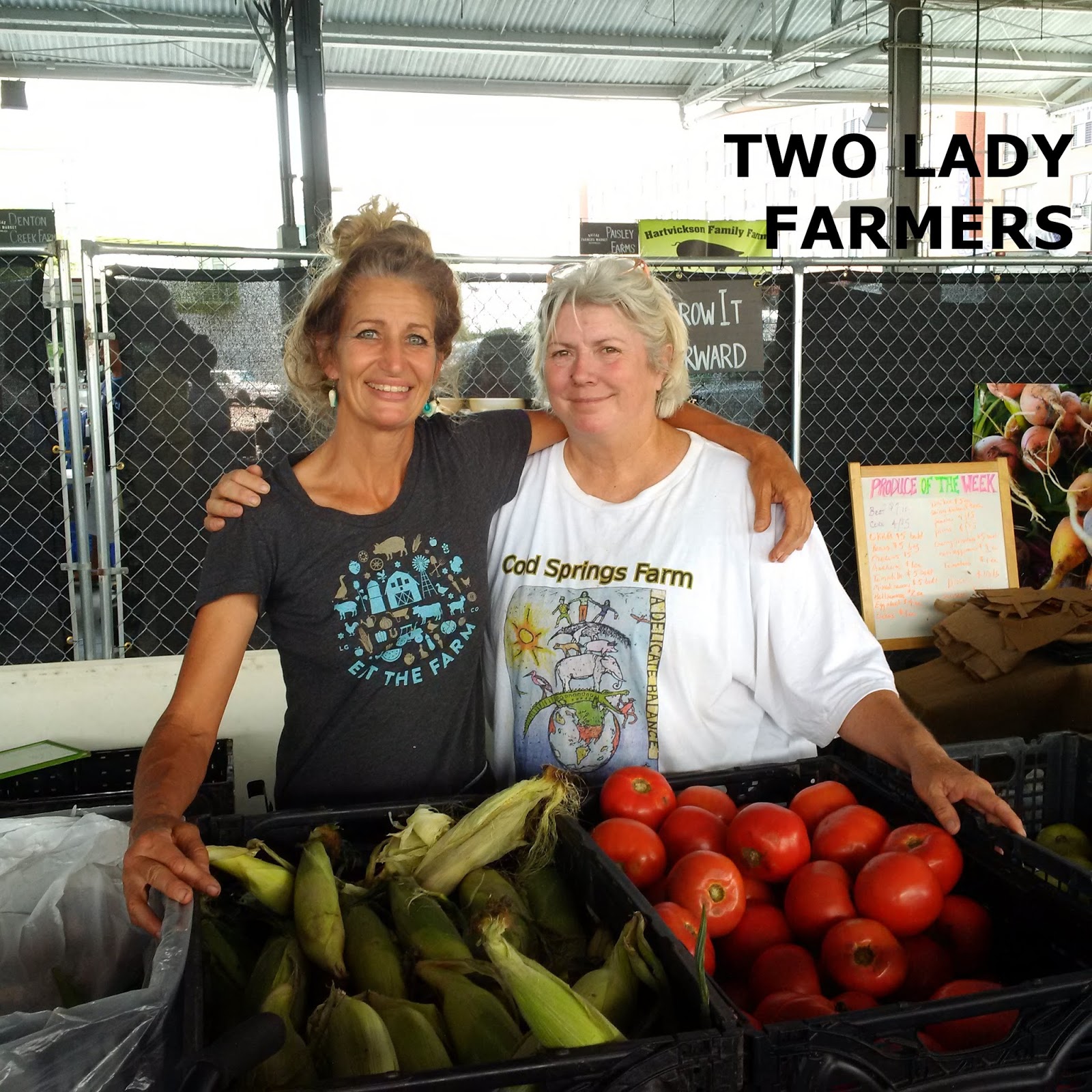
Cold Springs Farm CSA is west of 35 and needs full share members for the summer season. Which will be starting late, b/c - RAIN. But Bev grows awesome corn, melons, tomatoes, cucumbers and more. 

Eden's is east of 75. I'm sorry, we don't service outside of downtown or Lakewood. I'm one person. Bev is one person. We don't have a fleet of drivers or even another part time employee. It's one woman operations. Two Lady Farmers, remember? Till the Dallas farmer's market went back to wholesale selling and treating their farmers like dirt. Now we each are back to CSA and a local market. But we need you to buy. Highway 19 produce and berries lost a ton of crops this spring to flooding. They're out east of me. They need your help, too. 

If a farmer has value added products - buy them. They also make great gifts if you don't happen to like pickled okra, dilly beans or whatever they had time to make. Yeah, $9 is a lot for a jar of vinegar and veggies - but it was made with care, attention to detail, by hand, in your farmer or artisan's kitchen - with you in mind. That's pretty priceless.


Many farmers farm as their sole way of earning income. They really love what they do, but if there's not enough of a market to buy what they grow, they can't stay in business. and then what? 

You are forced to then buy food grown from a big, faceless farm. And you'll complain. So why not complain about the small farm's prices and being out of the way to get to; than the big one's facelessness and all that comes with it?


This is not a local DFW issue. It's happening all over the country. More farmers are committing suicide now than ever before. Farming used to be sustainable. It CAN be. But we have to have a market for it. YOU are our market. 

No one expects anyone to spend all of their grocery money with one place. Find something you can afford or that you know you can't find at the supermarket, and commit to getting it from your favorite local farmer, dairy(wo)man, rancher, fisher(wo)man, artisan, etc. 

We'll all be glad you did.


Eat Your Food - Naturally!

 Marie

PS - my hat is off to all small business owners everywhere. Owning and running one is hard work. Endless hours spent thinking, planning, doing - only to have an employee or you make a mistake that costs money and time lost, or Nature - in the case of farming - wipe out an entire planting, which can't be replaced for weeks, because, farming is not magic.

Keep doing what you do because it's worth it to someone. Hopefully it's worth it to YOU. If it's not - it may be time to do something different. Life is short and hard work is one thing, but please, don't risk your health or life for it. And whatever you do, don't end your life over it. Too many people value you beyond what your business is. Taken from the original post off FB that started this blog entry - if you are a farmer reading this and you feel helpless, hopeless and lost... there is help, and there is support. https://farmcrisis.nfu.org/