Showing posts with label cheap food. Show all posts

Sunday, January 4, 2015

Back to the Ground - Part II


Last post I mentioned that I’d share some gardening tips with you. Since I started gardening back in the 80’s, a lot of new things have come to market, but for organic gardening, it’s pretty much the same story – feed the soil. But what if you are starting from scratch – in other words, starting from a lawn - how do you get started?

I wish I’d learned about permaculture a long time ago because my farm, and previous yards, would look a lot different. But, we learn and implement what we do as information becomes available to us and from that, we often grow. In this case, literally!

So I’m going to share with you a bit of a modified version of how I used to suggest starting a garden from an existing lawn area. And this is true even if you just have an overgrown patch of weeds, too. But many reading this are converting lawns to gardens – and YAY for that!

I generally start out my gardening classes with the disclaimer that my way is by far not the only way and that I don’t hold all of the answers. 

Much of what I have learned and apply today, was learned by listening to others who have much more wisdom and experience than me. I always try to remember my sources to give credit, too. That way you can look up more information or clarify something I’ve said. 

In this case, the method I’m going to share with you is part of a permaculture technique called “Sheet Mulching”. This technique has been called a variety of things and is taught by many others in various forms, including brilliant homesteader and wonderful gardener and author Ruth Stout who wrote How to Have a Green Thumb Without an Aching Back.

Toby Hemenway is the author of an awesome book called Gaia’s Garden. If you’ve not ever read it, I’d really suggest picking up a copy. It’s a great resource guide that I was told about while taking a permaculture class given by Larry Korn, who studied under another great teacher, farmer and author of yet another great book, called One Straw Revolution, Masanobu Fukuoka. So what I’m going to share with you, is nothing new, but it’s certainly revolutionized many people’s gardening attempts, and it seems permaculture is making a broader appearance lately. 

Step 1, in my opinion, is to start small. Seriously. Once you get an idea of how much time the upkeep will take you for the size plot you start with, you can gauge whether or not you’d like to increase the size the following season. But let's not bite off a huge chunk and let it get away from us the first season. It's not really difficult to grow some of your own food, but it will take some time.

Plot location is as important as plot size in that you need to have at least 4-6 hours of (preferably) morning sun. Afternoon sun really doesn’t benefit growth as much do the sun’s rays during the early part of the day. There are some plants that can grow without much sun, and if you’re patient, you can still have a garden with only 4 hours of morning sun. But let’s hope you can find a corner or plot somewhere with a bit more than that. 

So, now let's say we’ve selected a nice, manageable slice of land that gets at least 4 hours of sun.
Here’s the abridged directions of what Toby calls the “Ultimate, Bomb-Proof Sheet Mulch”;

I would change one thing around, just to make it a bit easier, and that is to mow grass/weeds low before you start, rather than after his step 1, as he outlines in his book. Leave the clippings on the ground.

  • Water area to be prepared the day before – or better yet, plan to do this the day after a good, soaking rain.
  • Add any soil amendments needed for your soil type. Such items would include, lava sand, rock phosphate, perhaps some kelp meal. We’ve discussed soil amendments a few times before (or you can check the web site for more info.)
  • Loosen heavy clay, using a garden fork. You are not digging or turning the soil. Just push the garden fork in and rock it back and forth a bit, all around the site. This adds air to the soil and allows amendments to soak in faster as well as give soil critters some wiggle room. 
  • Add a thin layer of a source of nitrogen. You can use a general organic fertilizer like Texas Tea or Lady Bug, cottonseed meal, feather meal or even some decomposed farm animal manure. Horse and chicken manure is in abundance here, so that’s generally what I use.
  • Layer with several sheets of newspaper, or, much easier to use, large pieces of cardboard. Be sure to overlap the edges by about 6 inches, to block out light. That is KEY! Newspaper needs to be about ¼ - ½ of an inch thick. Weeds can push through otherwise. Wet each layer thoroughly as you lay it out. Hopefully, you saved some rainwater from the last rain event.
  • Sprinkle another thin layer of the nitrogen source over the “sheet” layer.
  • On top of this, add 8-12 inches of a bulk mulch material, like finely ground tree trimmings, leaves, (abundantly available this time of the year) or even old straw bales. Be careful NOT to use old bales of Bermuda grass hay. It can have seeds in it and we don’t want to go “there”!
  •  Wet this layer down well. It will encourage rotting of any weed seeds that may be present and help material to break down faster. The consistency of a wrung out sponge is what you’re looking for.
  • Now, add a layer, about 2 inches thick, of compost. Homemade is the best, but if you’re just starting out, you may need to buy some. Give me a call and I can order it bulk for you and have it delivered to your house. I have a favorite source I’ve used on and off for many years back when I was doing landscapes and had a more active garden center. They test their compost regularly and it’s safe for use in a vegetable garden.
    • (Before you partake in any “free” compost, ask questions.
      • What is their source of raw materials?
      • Do they test it for herbicides? (You don’t want to apply some kind of herbicide ridden compost to your new garden. Not only would it defeat the organic component, but if it’s got a broad leaf weed killer present, you’ll also damage your desired plants’ growth.)
  • If the compost isn’t moist, wet it down.
  • Top off with a nice clean, weed free layer of shredded mulch. I like to get free mulch from local tree trimmers. You can also use a thick layer of leaves, however when they dry, they tend to blow around. Mulch’s job is not only to provide a nice, finished look, but to help reduce erosion. 
Note; You may choose to edge your garden plot with metal edging, some decorative bricks, non-treated lumber, or, just give it about a 12" mulched border between any remaining grass and your first "row". That way, you can keep the weeds and grasses from sneaking over into your garden across the mulch more easily. 

That’s it! You now have a garden in the making. Go back inside, make some hot tea, look at some seed catalogs and dream!

The winter rains will help break down the layers of newspaper or cardboard and all of that yummy organic matter will be creating a wonderful, living layer of topsoil, complete with earthworms and other beneficials, and a growing bed for your new spring garden, while you wait out ol’ man winter.

You actually can plant sooner, if you want to, by slicing open the newspaper/cardboard and setting weather appropriate seeds or transplants over the openings.

Onions are not fans of weeds and this type of weed free garden bed may be a super easy vegetable to start with. “Onion Sets” are available here at Eden’s as well as in most other garden and feed stores. Look for “short day” varieties.

NOTE: I suggest waiting until about mid February as onions are biennials and can be “tricked” into their 2nd growing season by our topsy turvy temperatures. But many people have planted early and get a decent to very nice crop planting at various times. There’s no hard and fast rule with onions and when you’re not planting hundreds of row feed, you can afford to take a few risks. But just a word of caution; if planted too early, some may begin to flower before they finish making a full sized bulb under ground.

If you’re a rookie, you may want to start with transplants this spring for things like tomatoes, peppers and eggplant, which can be a bit tricky starting from seed.
But for squash, melons and other larger seeded veggies; go for it! Direct sow them, according to directions on the seed packets or our spring planting guide (available at the shop), and get ready to watch them come up.

The roots of seeds or transplants will find their way into the nice, rich and weed free plot you’ve created without breaking your back, a shovel, renting a sod cutter or hiring a crew to dig up the grass.


Git Yer Hands in the Dirt & Eat Your Food - Naturally!

Marie 

Thursday, December 4, 2014

Acres USA's December Issue - The Untold Chapter


Earlier this summer I was interviewed for a story in Acres USA’s magazine, known as “The Voice of Eco-Agriculture”. Acres USA is “North America's oldest publisher on production-scale organic and sustainable farming". The magazine is available at various book stores and news stands and you can read the full article there.

The interview was about specific challenges I experience as owner of an urban farm. And writer Rita Cook notes in the magazine index tease; “…..she has overcome these challenges and continues to focus on growing in harmony with nature…” Staying focused on the end result, “….to produce fresh, healthy food for the local community.” is the best way I know of to be successful.


One of the questions I was asked, concerned any benefits there might be to owning an urban farm. There can be several, namely accessibility to the farm for consumers, which could be considered a built-in market. However, I explained it is only a potential market. As with any business, just because you build it – doesn’t always mean they’ll come; even if they can walk to it. Marketing plays an important role in consumer’s choices.


I added that along with that built-in market, came built-in competitors as well. As the popularity of local food and all things related has increased since I opened in 2007, about a dozen or so other well financed, neighborhood “farmer’s markets” and “CSA’s” have popped up all over the DFW area.


Do they have farmers who actually grow the produce being sold? Some of them. Is it clear which ones don’t? Not always. “Why is this a big deal?” you might ask. It’s a story in and of itself that I’ve touched on many times, but probably bears repeating.

I replied to that question in a part of the story that wasn’t published. With a few additional thoughts I’ve added since the interview, here’s what I said.

I’ll let you decide what the big deal might be, from the farmer or a consumer’s perspective.

Accessibility is of course one of the certain pluses. It is not only convenient for customers, but it makes deliveries of produce to the farm’s restaurant accounts less costly than for many out of town farms.

As far as the larger customer base, this has its up and down side. The extra people living in the area means the market is also desirable to many other businesses vying for the same thing. And I’m not talking about other small farms. Medium to large food buying clubs, middle man run food co-ops and out of town large farms that use their marketing dollars to tout “to your doorstep” deliveries of “local” food are all here, too.

This gives the consumers what has become a wide, yet confusing, choice of ways to eat better. However, it has also put a sort of wedge between the farmer and the consumers' plates by encouraging the old “get bigger or get out” mentality in order to be able to compete. Right in our own backyards.


I don’t think many consumers really understand that when a middle man gets involved between the farmer and the end consumer, about half of the gross profit for the farmer is lost. The one who made this food possible in the first place.

Try to think of it this way; if he, or she, gets paid 50 cents of the retail dollar for those tomatoes the customer paid $5-$6/lb; a farmer is working tirelessly to grow and protect 10 acres of the most gorgeous, delicate, hard to transport and delicious fruit around – and essentially gets paid for only 5 acres. 

I’ve recently seen several farmers stop farming because they just couldn’t afford to do it anymore. This is a sad, and scary, trend. Especially when we're talking about trying to replace the ever aging current farmer base. 

Small farmers can’t afford to donate half of their time or product any more than anyone else can. And yet, in the form of their net profits, it’s often given to a middle man who can choose to buy from any source, local or not, big or small, based on price, (read profitable - to the middleman). This is often done in order to supplement their customers' “shares” with out of town, out of season produce, just to keep a bounty in their customer’s basket. If local weather or other conditions are affecting actual North Texas local farms’ yields, this practice is a direct conflict of what the original CSA movement was meant to be about, and has confused many customers. Or at the very least, has certainly not done a very good job exposing them to the reality of farming. Which is a large part of what the whole "local food" movement is about, right?

The customer doesn't share any risk with the farmer in a food co-op or an on-line grocery ordering system where its "pay as you go". And as far as I know, neither does the food co-ops' owners.  CSA is also supposed to be about sharing the risk with the farmer - to help keep the farmer's supported, “bounty or bust”. The farmers plan, plant, cultivate and hope for the best. But committed CSA members of a farm don’t bail out if grasshoppers or an early, hard freeze ends the season unexpectedly.
Instead, these customers have developed a relationship with that farmer, their farmer, and know he or she will do their best to make it up the next season. Cash refunds are rare, as CSA funds are collected and used as "seed money" at the beginning of a season.  That's part of the concept, too. Banks aren't as forgiving of crop failures, and many urban farms sit on prime tax base properties that are under agricultural valuations. (Even if it takes many more years to achieve than it should have.)

The pressure is already great to provide our customers with the best we can grow for them, because most farmers take a lot of pride in what they do. But it’s really difficult to compete with the marketing campaigns and misuse of descriptive terms, like co-op and CSA, when even major local media coverage interchanges the words and doesn’t make clear the differences between the various programs. 


This difficulty is especially true if the consumers' main objective the convenience of a weekly selection of a wide variety of what they are used getting from the supermarket, dropped off at their doorstep. They may not even realize that the small farm touted when they joined, may no longer even part of their "share" because of a crop failure or had a crop that was rejected by the distributor for a few bug holes in the leaves of a crop grown organically. (Excuse me, do you want us to grow without synthetic pesticides? Then you're sometimes going to have a few holes in your cabbage leaves.)

We waste so much food in this city; food that healthy meals could be made from, and given to the people starving right here in our own back yards. People living in food deserts, where, ironically, my farm is located along the edge of. But that topic, is again another story in and of itself. One I'll try to cover another day.

But some customers are so out of touch with the differences between these middle man food delivery services and CSA's, that in the same year that Eden’s and another small local farm were named “Best CSA” in a tie by the magazine’s staff, a readers choice award in the same publication for “best farmer”, went to one such local food distribution company, instead of an actual farmer. (I didn't even notice farming as a category in this year's "best of" version. Probably just as well.)

Abraham Salum - one of my farm's first local chef supporters
There’s still seems to be a real disconnect, even though the topic of local food and being in touch with its source, has risen to new levels in the past 5 years. Locally, that is in large part thanks to the publisher of the 5 year old magazine Edible Dallas and Fort Worth, Chefs for Farmers, a number of prominent chefs, as well as the various food documentaries that made it to some of our local theaters. National Eco-conscience companies like Chipotle have sponsored local expert panels to answer questions from the audiences after these films as well as large food festivals. Educational opportunities are out there, and growing bigger. I have hope for the future.

(If you missed them at the theaters, some films really worth seeing are Fed Up, Food Inc., Cafeteria Man, GMO OMG!, GROW!, Fast Food Nation, and Fresh!, the film my farm premiered here in Balch Springs back at our periodic fund raiser BarnAid a few years ago.) 


So, really the best thing I can do to not look like a sour grape, is just tell the story of what I’m trying to do here, and rally the support of those who want to help achieve the goals I’ve set.


I try to encourage people who really want to be on the front lines of food justice and eating locally grown, clean food, to join me and pledge their support with a CSA membership or to buy as much of their family's food as they can by other farmer-direct methods. 
As Alice Waters so eloquently put it many years ago, and I paraphrase here; everyone has the right to eat good food and to make a fair living. I think that there are plenty of ways to do both, without doing so at the expense of others.
 
And I think the, successful on-line fund raiser I recently held for the farm, is perhaps a testament of the achievement of this farm’s outreach. 

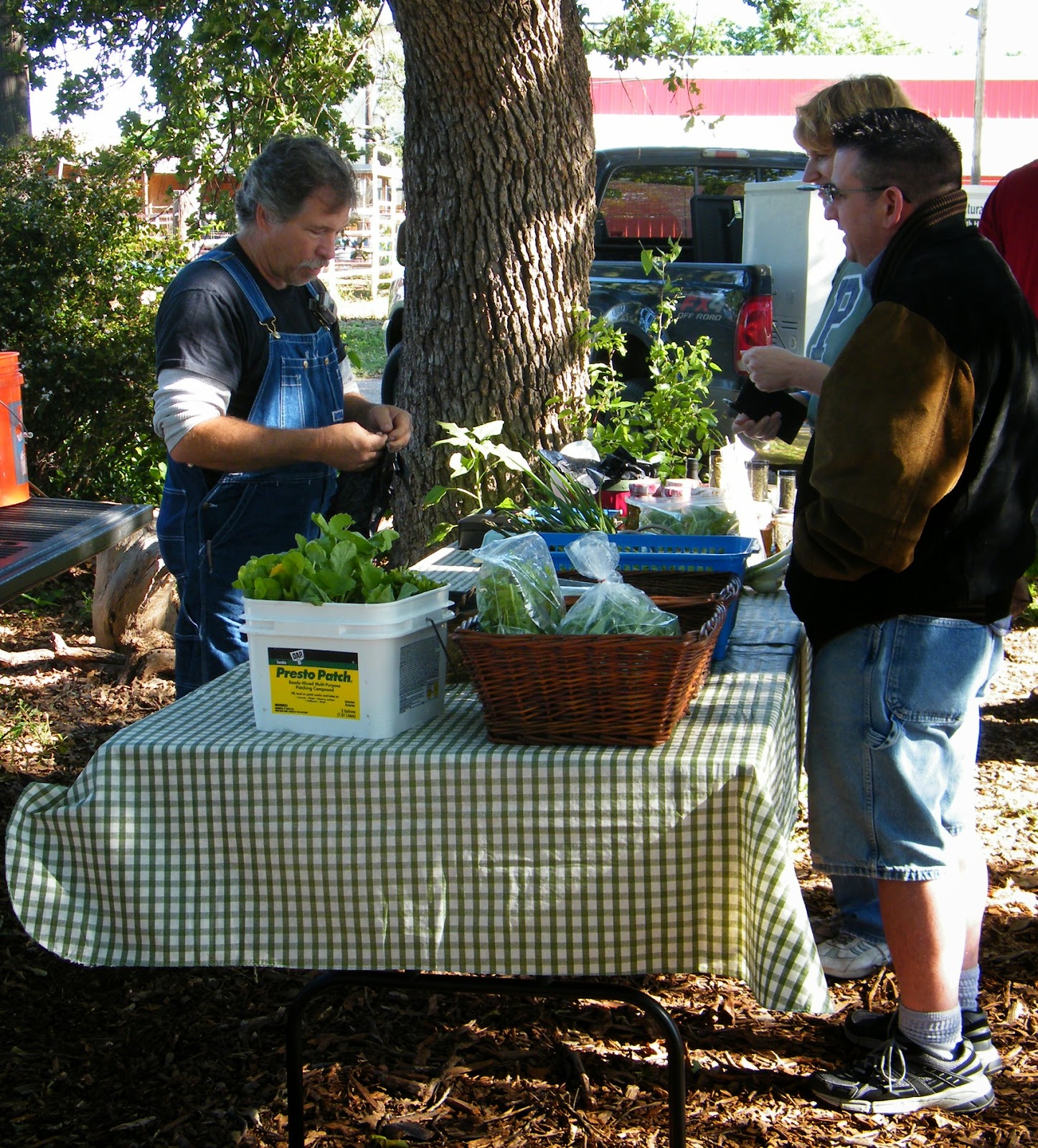
But not all farmers have such prominent public voices. Being urban has also afforded me that privilege. So holding a small market here on my farm to help give fellow farmers a place to sell their wares, has become an important cornerstone for my farm's mission. 

I still host the only market in DFW that allows only food grown or produced organically, meaning, without the use of synthetic pesticides, etc., or GMO's. Certified or not, I know these farmers and producers personally, and my customers have come to know them as well. We don't need a government sticker to back up our word. We work in our own fields and eat, and serve to our families and friends, the food we produce.

Let the local growing continue, and let’s hope convenience and price doesn’t always win out over small, local and real food, grown with integrity. The more demand for transparency there is, for food grown naturally and truly grown locally, the more it will become available.

Buy direct from the grower or producer as much as you can. It's really what the big benefit of having local farms around, is all about. And get involved! There's a current movement going on to help loosen restrictions on community gardens and urban agriculture in the City of Dallas.


Now Go on and Eat Your Food - Naturally!
Farmer Marie