
As you may have seen circulating recently, one of the long
serving members of the National Organic Standards Board (NOSB), gave a somewhat scathing “exit interview” of sorts, upon his term expiration. It followed a quite heavily
attended recent meeting, in Florida, at which during a very close vote, a newer, and somewhat controversial,
method of farming was granted permission to use the Certified Organic label. (Pending
final approval by the USDA)
I imagine most of these meetings are somewhat uneventful. This one,
however, was attended by the likes of organic farming pioneer Eliot Coleman,
who practically invented the modern day practice of organic Four Season Farming – in a climate
that generally folds up and puts away its gardening duds around Labor Day. This
was no ordinary vote. This was considered an historical decision by many.
As you can read for yourself, Francis Thicke is leaving the board a bit
troubled at what he’d experienced over the past 5 years as a NOS board member, as well as this final change. And it’s led me to consider the ramifications
of what he’s laying out and how we can do something, locally, to help counter
them.
Would you like to pay the cost of a higher quality car that simply had a different brand’s emblem glued on the trunk?
Many of us have seen something like this coming, the erosion and
abandonment of, the USDA’s Certified Organic label. Once it stood to
differentiate superior foods grown in soils that had been painstakingly cared
for through practices as old as dirt itself.
 Farmers, wanted to be sure that those who simply farmed
conventionally, but claimed otherwise, we not able to scam the public and also
reap a premium. And people wanted to have some way of
being reassured that the extra effort they took, and sometimes a little extra
cost they spent, to obtain organic food, was justified.
Farmers, wanted to be sure that those who simply farmed
conventionally, but claimed otherwise, we not able to scam the public and also
reap a premium. And people wanted to have some way of
being reassured that the extra effort they took, and sometimes a little extra
cost they spent, to obtain organic food, was justified.
Would you like to pay the cost of a higher quality car that
simply had a different brand’s emblem glued on the trunk? Certainly not. And
while there are plenty of studies and claims out there regarding nutrition,
safety, and value, the bottom line is that false advertising is false
advertising. If you build a Ford, you can’t put a Mercedes emblem on the back and sell it as a Mercedes.
But now farmers, who had used organic farming and ranching methods for decades
before this label came along and the USDA created a new, trademarked definition of the word, were
not even allowed to say
they used organic methods anymore. Not unless
they paid the USDA to send out an inspector to their farm to look for things on
a list created by the NOS board and check them yes or no. They also must submit
a stack of record-keeping, including financial data and abide by what could be
considered by some a ridiculous (and ever growing controversial) list of
products sanctioned by OMRI, or GRAS.
It has been coming to light for many years that the bigger ag producers
wanted a piece of the tiny little pie organic farmers had baked for themselves.
And as that has happened, they have slowly amended the list of ingredients to
include things you would not normally find on a typical organic farm.
Oh you might find an old bottle of what is considered a cross-over or "blended"
fertilizer, to rejuvenate yellowing or nitrogen deficient crops during streaks of
cold, rainy days when the soil feeding biology is asleep, dormant from the colder
temps. Or kickstart with it if biology is absent altogether in a leached out or soil-less seed starting mix where a farmer may be desperate to keep seedlings alive when, for instance, wet conditions have kept them from transplanting and they are suffering nutritionally. This is rarely, if ever used and generally is backed up by a good dose of biological stimulating, too. Organic farms depend on this biology to keep soils alive!
You may even find a bottle of some kind of weed killer the farmer used to
kill that persistent patch of poison ivy near their tool shed where they kept brushing against it
and getting the itchy, painful rash no one wants to suffer.
But rarely, if ever, did you hear of them locking up their cows in a
huge confinement barn, depriving them of access to the out-of-doors or their natural type of
food – grass, and instead replacing it with artificial lighting and grain or
other organically grown (hopefully), feed mix. (But when you have imported fraudulent “organic” grains, who knows what these cows were eating?)
I
wanted to create a bit of a utopia I guess.
A place where the public knew the food they’d buy was safe to eat, because I knew, or got to know, the producers and the methods they practiced; and, the producers knew they’d get a fair shot at selling their product because I’d not allow a 2nds and surplus dumping ground and had worked to cultivate a public that appreciated the value and the slightly higher cost sometimes associated with small, organic growing operations.
A place where the public knew the food they’d buy was safe to eat, because I knew, or got to know, the producers and the methods they practiced; and, the producers knew they’d get a fair shot at selling their product because I’d not allow a 2nds and surplus dumping ground and had worked to cultivate a public that appreciated the value and the slightly higher cost sometimes associated with small, organic growing operations.
It's sad to me because I know some of the early pioneers who proudly
displayed that label. Even though it meant paying “the man” not to put poisons
on their own land -something that has never made enough sense to me to join
them. Meanwhile, those who create toxic cesspools that freely travel our
bodies of water causing pollution world-wide, pay nothing.
 And many paid up for decades. Putting up with constant increases in
fees, changing lists of record-keeping requirements and all the while watching
large corporate run farms bend the rules, or make new ones, because,
quite frankly, the spirit of organic farming was never MEANT to apply to huge
swaths of monocultured crops. It’s not a method meant to be applied to a
mass-production, big agri-biz assembly line. It’s just not.
And many paid up for decades. Putting up with constant increases in
fees, changing lists of record-keeping requirements and all the while watching
large corporate run farms bend the rules, or make new ones, because,
quite frankly, the spirit of organic farming was never MEANT to apply to huge
swaths of monocultured crops. It’s not a method meant to be applied to a
mass-production, big agri-biz assembly line. It’s just not.
Organic is not a list of what you are or are
not supposed to use. (Which is, in part, why the addition of the label to a soil-less farming method has so many up in arms.)
So, this brings me to the main point for all this rambling. If I’ve not lost
you yet, yes, there is a point.

When I first opened Eden’s Organic Garden Center, the last thing on my
mind was to become a farmer. I was first an organic gardener, primarily
interested in helping people grow a safe and pretty yard.
I wanted kids to be able to run through their yards without worrying
about absorbing poisonous ant killer through their feet. Or, putting it into their
mouths. I wanted pets to be able to roll in the grass and not carry any kind of
toxic flea or tick killer into the house to be rubbed on the faces of their
families. I wanted to create a safe paradise – hence my original tag line “Your
Paradise Found”.
I morphed myself into a farmer, you could say, because I grew
increasingly aware of the toxins present on food found in grocery stores. At
the time I had started the garden shop, my yard was mostly shade and didn’t
grow much of a vegetable garden. I, like many of you, relied on the supermarket
for my food because I was a bit discontent with the city of Dallas’ farmer’s
market; both the layout and the fact that tropical fruits were being shoved in
my face were both unappealing and offensive. I’d not yet discovered a market
nearby that was open at a time my shop wasn’t and I had to work.
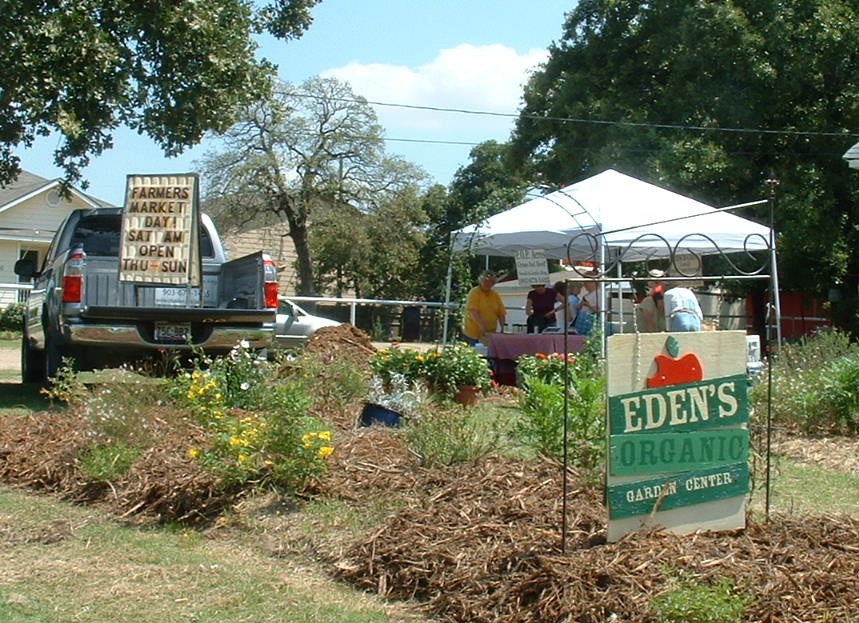
So, when I moved the shop down to Balch Springs and nearly lost my
shirt doing so, I decided to invite organic, local, at the time, TOFGA (Texas
Organic Farmers and Gardeners Association) farmers and ranchers to sell their
wares at a once a month, old fashioned, “Market Day” I’d host on the shop
grounds. It was a bit self-serving and at the same time, community serving, as I'd learned first hand what little access to really fresh, much less organic, produce there was to a person without their own transportation or with low income. I couldn't qualify for SNAP, but those who did, would be able to use it here for produce and vegetable/fruit plants and seeds.
I had also heard rumblings from farmers and ranchers of TOFGA that the
big market wasn’t always a fair playing field for them because of the price
gauging by non-producers that re-sold product that was often inferior. So I wanted
also, to create that level playing field for these people who I’d come to know as hard-working
folks just trying to scratch out a living while feeding the public safe to eat,
nutritious and tasteful food.
I wanted to create a bit of a utopia I guess.
 A place where the public
knew the food they’d buy was safe to eat, because I knew, or got to know, the
producers and the methods they practiced; and, the producers knew they’d get a
fair shot at selling their product because I’d not allow a 2nds and surplus
dumping ground and had worked to cultivate a public that appreciated the value
and the slightly higher cost sometimes associated with small, organic growing
operations.
A place where the public
knew the food they’d buy was safe to eat, because I knew, or got to know, the
producers and the methods they practiced; and, the producers knew they’d get a
fair shot at selling their product because I’d not allow a 2nds and surplus
dumping ground and had worked to cultivate a public that appreciated the value
and the slightly higher cost sometimes associated with small, organic growing
operations.
The Market Day events grew pretty quickly at first. I was the only one in the DFW
area who could claim to be an all farmers/ranchers and all “clean” or certified
organic farmer’s market. I believe I still am the sole market that can make
that claim. And at the time, I was one of only 2 or 3 other local markets.


The popularity of the theory of this kind of market has grown. The
market’s attendance by both farmers and customers, has suffered, however. In part, the influx of so many communities
hosting their own “farmer’s markets”, and the recent overhaul of the big
downtown market, means farmers have had to focus on higher traffic markets and
people typically want to stay close to home if they can.

However, as is also making the local news lately, many of the people responsible for those changes at the downtown market,
have themselves changed out and many of the standards have gone away
with them. “Meeting customer demand”, is what we’re told. It seems a large
enough consensus of the DFM shopping public either doesn’t understand local, in-season
shopping, or just doesn’t care to have a market that abides by the principals
of a producers-only, in-season, local food farmer’s market.
I, on the other hand, do
understand, and care.
And I know many, many of you
who do also. I hear from you almost daily. I don’t see nearly enough of you,
however, at the little community market twice a month that I have been struggling to keep running
for the past 10 years.
I know, many now have to work weekends, or families have various
activities planned for their kids on Saturday mornings. Sadly, they don’t seem
to include a trip to their local urban farm to shop at the market. (I was a
kid, I hated going grocery shopping, I get it.)
But many of you do, apparently, shop at these ever increasingly popular
“faux” farmers markets or there wouldn’t be so many of them popping up across
the DFW area. And the one’s I’m talking about are not featuring local, small
batch, or in-season, much less, organically grown, produce or products. You
might stumble upon one that has some gardeners there – and hooray for those
few. But many are, as one fellow grower called them, “farmerless farmer’s
markets”
I need your help understanding what it will take to bring this little market that could back to full
steam.
Because now more than ever, perhaps, as our certified organic label
takes yet another beating, and more and more farmers leave it behind, you probably
want a place where you can go that you can trust the faces behind those tables and the food.
I’m honored that so many of you have come to trust me to vet farmers
and ranchers that sell here. That the food coming here to be sold is safe
to consume, is very important to me. I've uninvited or not included a handful of farmers or products that I felt had less than righteous intentions or didn't meet the standards for the kind of products I wanted to carry. And I've also mentored a few previously conventional growers, over to the "non-conventional" ways followed by myself and many of my colleagues. We can always improve, and I will always strive to do better.

While I intend to keep the focus on fresh produce and other raw
ingredients like grass-fed meats, wild caught fish (from fishermen I have come
to know and trust), and small batch artisan value-added foods, I also want to
grow the market to include some activities that enrich the experience.
 I’m in conversation with chefs about providing cooking demonstrations and on farm meals. We
can bring back the food competitions like our chili cook off, salsa/pesto
challenge, ice cream crank off, farm to screen events and kids’ activities, too.
I’m in conversation with chefs about providing cooking demonstrations and on farm meals. We
can bring back the food competitions like our chili cook off, salsa/pesto
challenge, ice cream crank off, farm to screen events and kids’ activities, too.  But coordinating these things takes legwork. And the two hours or so it
will take me to type, edit and produce this piece is easy to do today since the
animals are fed and there’s a cold steady November rain outside, and I’ve run out
of vacuum cleaner bags so I can’t do anything much else right now anyway.
But coordinating these things takes legwork. And the two hours or so it
will take me to type, edit and produce this piece is easy to do today since the
animals are fed and there’s a cold steady November rain outside, and I’ve run out
of vacuum cleaner bags so I can’t do anything much else right now anyway.
But this needed to be said whether it rained or not. I’m just glad the weather gave me
the opportunity to give it so much thought. Even though it made for a long
read. Some things are worth taking the time to explain in a bit of a drawn out way. I think this is one of those things. There are a lot of moving parts to the local food movement. And they're not always pretty. It's become a way of life for me and it's worth defending and explaining. If I need to take a morning to do so, I will.
I really enjoy hosting Market Day and have come to love growing food for people who really appreciate what
I and so many others I know do for a living.
I saw a few thousand and met at
least a hundred of those people, chefs and the general public alike, over the past weekend at the Chefs for Farmers marathon of
events. “Tell me about your farm!” “I love what you’re doing!” “Thank you for
doing what you do!” It was music to my ears and that I'm sure of all of the other farmers in attendance. Want to make a farmer feel good? Tell
him or her how much you appreciate their work. Thank her or him for harvesting
in that cold November rain so you can have your CSA pick up at the regularly
scheduled time so as not to inconvenience anyone’s schedule and risk them
not-renewing their memberships.
I
need a few volunteers, at first anyway, to be able to consult with and explore
the best way for Eden’s Market Day to move forward.
More people from out of state are moving here to N. Texas, and they
have expectations for what comprises a “farmer’s market” because many of them came from cities that "get it". Many are wise to what
many who don’t know any better, are not. And they don’t know what to do to find what they're missing. Some
turn to home delivery options, I suppose, hoping they’re getting a
better quality product and are willing to pay for the convenience.
And many farmers are scrambling to save their businesses from this kind
of green-washing competition. No, most of those point and click national
companies, and even a few local ones, do NOT get most of what you buy from them
from local, (not local to YOU anyway) farms. There are some exceptions and I’ve
known a farmer or two who have had sufficient quantities to sell to them sometimes.
But then we have to ask ourselves about the carbon footprint all of that
packaging leaves. I know, it’s always something. And once in awhile, buying
this way may not make a big difference in the big picture. But you should at
least know what you’re buying, right? And if it’s causing others or our planet to
suffer, do we still want to support it just because it’s easier/cheaper? That’s
up to you.
I want to help small farmers, and I want to provide a service to those of
you who say no to that question. But I need your help in the way
of participation, too. I’m a one woman show and I can not continue to be
effective and do it all.
I need a few volunteers, at first anyway, to be able to consult with
and explore the best way for Eden’s Market Day to move forward.
 Do we keep it a private market and look for funding sources to run it?
Or do we take the big 501C3 plunge? That costs money and requires paperwork
upkeep, etc. It certainly opens the door to lots of funding sources, but that,
too, comes at a cost.
Do we keep it a private market and look for funding sources to run it?
Or do we take the big 501C3 plunge? That costs money and requires paperwork
upkeep, etc. It certainly opens the door to lots of funding sources, but that,
too, comes at a cost.
How do we reach out to our local communities here in southeast Dallas County? We have a private bus service that runs 6 days a week now, so transportation for those without their own is better. But we still need to communicate to everyone the value of making the trip and the best way I know to do that is to bring them right to the source.
Help me help you. My ears are open and I check email often. It gets
crammed up with spam frequently, so be patient if you don’t hear back from me
right way. (you can help me sort through it by having a clearly stated SUBJECT line.)
 I firmly believe, that people who participate in their food’s journey,
choose better and that those involved in a project are more likely to support
it. It’s possible that the past 10 years out here on my farm have left me out
of some loop of society that would cause my thinking and beliefs to be
mistaken, but prove me wrong, or please, help me engage people in what we're all pretty passionate about.
I firmly believe, that people who participate in their food’s journey,
choose better and that those involved in a project are more likely to support
it. It’s possible that the past 10 years out here on my farm have left me out
of some loop of society that would cause my thinking and beliefs to be
mistaken, but prove me wrong, or please, help me engage people in what we're all pretty passionate about. 
What is the value of a small, urban farm? One that you can pretty easily take your
kids to, every week or every other week, for free, and where they, and you, can
experience small livestock, food growing in the ground, and food being
harvested in real time, the fresh aroma of freshly harvested foods and the
peace of mind of knowing where at least some of the food on your plate comes
from?
Is it worth a few hours a month to help out? To possibly stand in
for a farmer who can’t be in 2 places at once? To perhaps run out to a farm an hour away in your gas efficient auto, (unlike the '86 F150 I drive), to
pick up some boxes of goodies they want to sell, but have to get the next
seasons’ crops in the ground because the timing is critical?
If you can answer yes, that the value is worth doing any of these things,
then please, shoot me an email, give me a call, or set up an appointment to
meet with me.
People in southeast Dallas county and all over the metroplex
deserve a market that they can count on to bring them Real Food, Grown with
Integrity. Let’s do this!
And if you’re
reading this but not in the DFW area, please, go ask your local, REAL farmer’s
market if you can help them. Or, see if a local organic farmer in your area can use your help getting their produce to the people.
Together, we can do better for the good of everyone. Whether the USDA wants to
help or not.


